

Algebraic expressions are a combination of variables, coefficients, constants separated by operations(\(+, -, \times, \div\)). Operations on algebraic expressions can be performed only on like terms.
Like terms
Terms having same variables are called as like terms.
Example:
- \(3x\) and \(2x\) are like terms. [Having same variable \(x\)]
- \(16ab\) and \(2ab\) are like terms. [Having same variable \(ab\)]
- \(7y + 3 + 5y + 1\). [Here \(7y\) and \(5y\) are like terms because of variable \(y\) and \(3\) and \(1\) are constants]
Unlike terms
Terms having different variables are called as unlike terms.
Example:
- \(5x\) and \(8y\) are unlike terms. [Having different variables \(x\) and \(y\)]
- \(3xy\) and \(12y\) are unlike terms [Having different variables \(xy\) and \(y\)]
These cannot be combined.
Addition and Subtraction of expressions
To add or subtract the expressions:
1. Identify the like terms.
2. Add/Subtract the coefficients of like terms.
Example 1: Add the expression \(2x + 7x\)
Here, \(2x\) and \(7x\) are like terms. To add the expression, let us add its coefficients.
\(2x + 7x = (2 + 7)x\)
\(= 9x\)
Example 2: Subtract the expression \(7xy - 15xy\)
Here, \(7xy\) and \(15xy\) are like terms.
\(7xy - 15xy = (7 - 15)xy\)
\(= -8xy\)
Patterns in calendars and matchsticks
What is a pattern?
A pattern is an arrangement of numbers, shapes, or objects that follows a particular rule.
Example:
1. Number pattern: \(2\), \(4\), \(6\), \(8\), \(10\), ....
Rule: Add \(2\) each time.
2. Shape pattern:
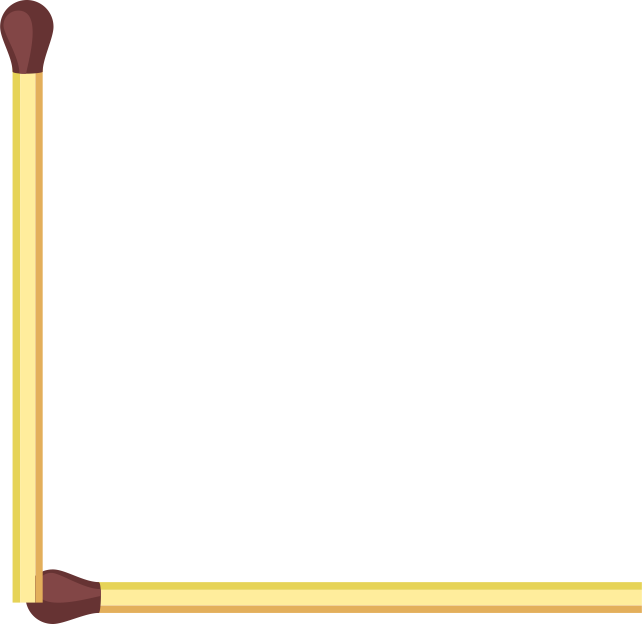
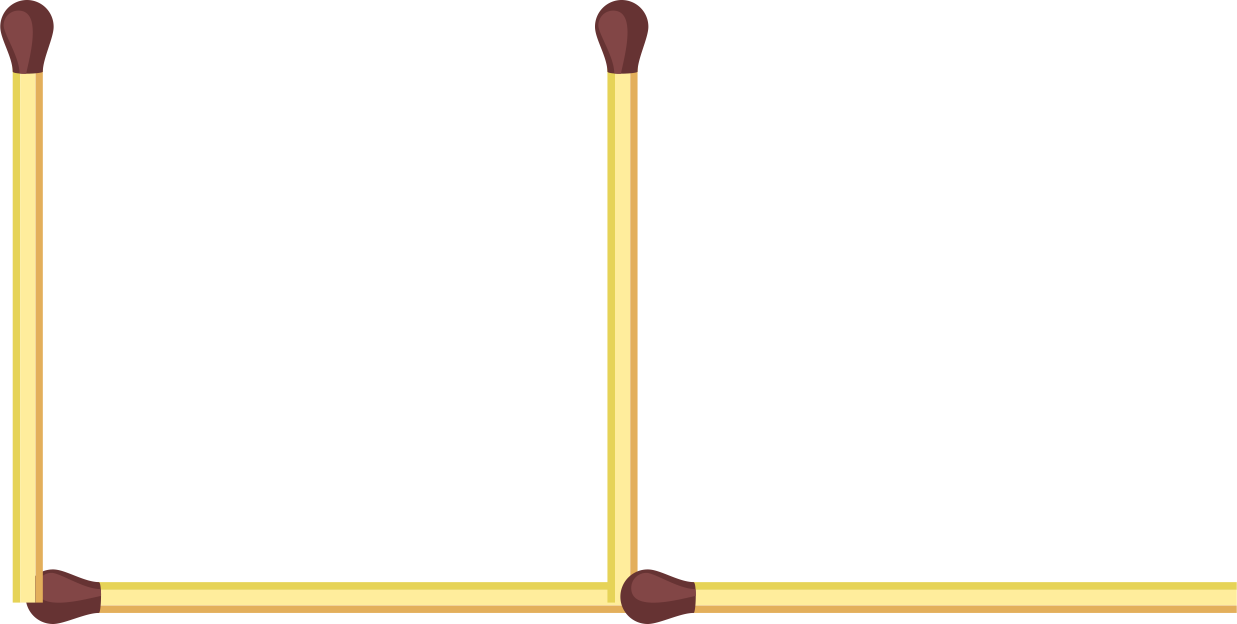
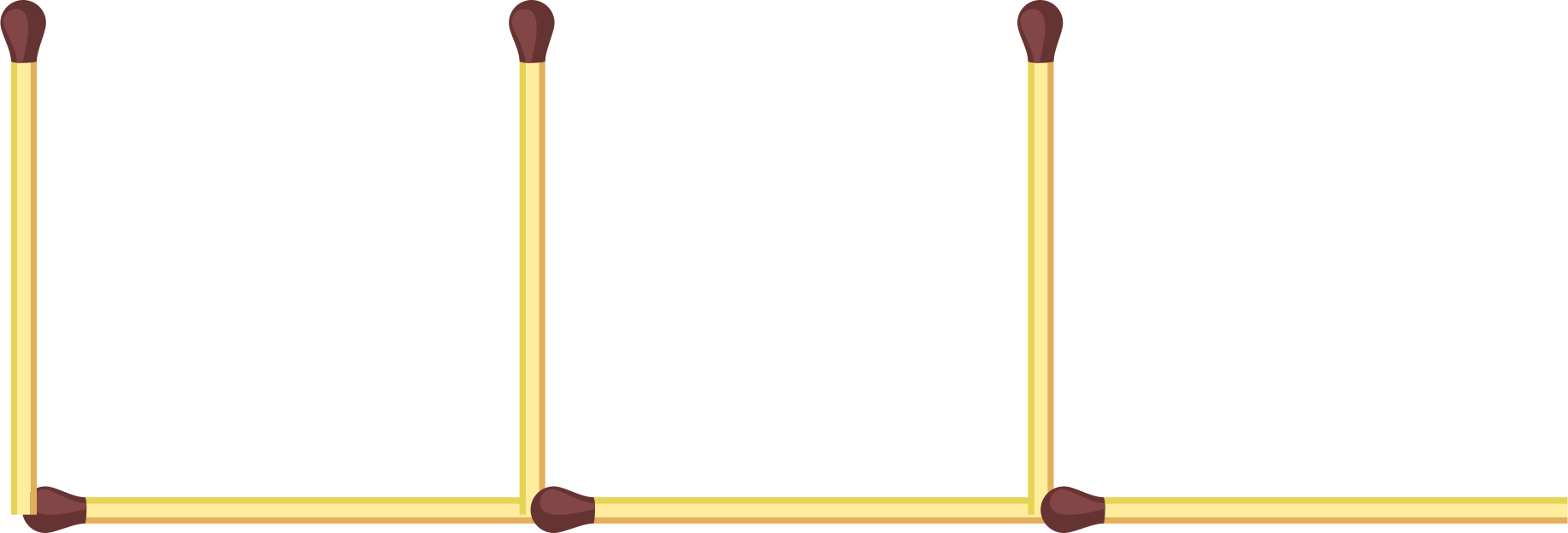
Rule: Add \(1\) letter each time.
Pattern helps us predict future terms.
Rule of a pattern(nth term)
To identify a pattern:
- Observe the numbers or shapes carefully.
- Check what changes from one term to the next.
- Write the rule.
Example:
Consider the sequence \(4\), \(8\), \(12\), \(16\), \(20\), ....
Here, we can see that each term in the sequence is a multiple of \(4\).
| Term number | Value in the sequence |
| \(1\) | \(4\) |
| \(2\) | \(8\) |
| \(3\) | \(12\) |
| \(4\) | \(16\) |
| \(5\) | \(20\) |
Therefore, the rule is \(4 \times n\) where \(n\) represents the term number.
Patterns in Calendar
| Sun | Mon | Tue | Wed | Thu | Fri | Sat |
| \(1\) | \(2\) | \(3\) | \(4\) | \(5\) | \(6\) | \(7\) |
| \(8\) | \(9\) | \(10\) | \(11\) | \(12\) | \(13\) | \(14\) |
| \(15\) | \(16\) | \(17\) | \(18\) | \(19\) | \(20\) | \(21\) |
| \(22\) | \(23\) | \(24\) | \(25\) | \(26\) | \(27\) | \(28\) |
Important observations:
Horizontal pattern of numbers: Add \(1\) to get the next number to the right.
Example: \(16\), \(17\), \(18\)
Vertical pattern of numbers: Add \(7\) to get the number below.
Example: \(5\), \(12\), \(19\), \(26\).
Diagonal pattern of numbers: Add \(8\) each time to get the next number in the diagonal.
Consider the diagonal numbers \(3\), \(11\), \(19\), \(27\).
Here, the difference between each term is \(8\).
Patterns in Matchstick
Matchsticks can form repeating shapes.
Suppose you are given with \(3\) Matchsticks and asking you to form the letter \(C\) using that. Your work might be like this.
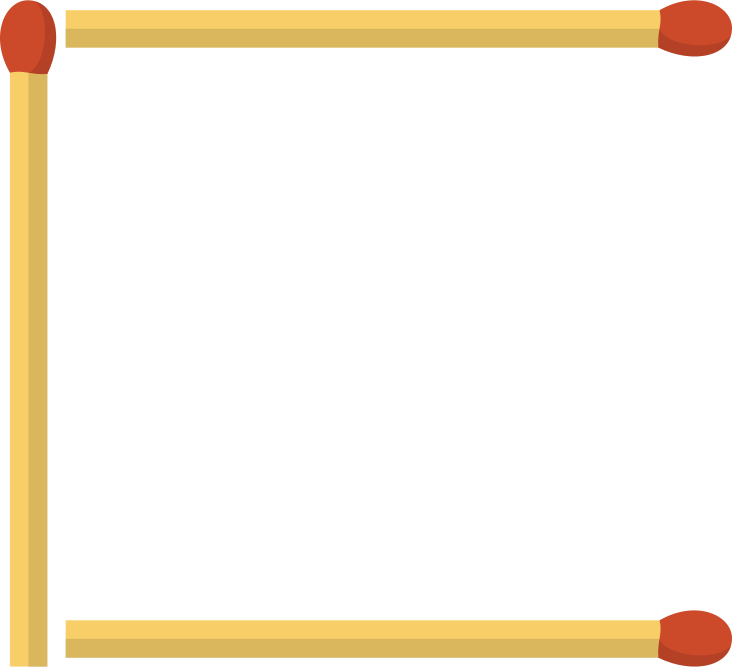
Suppose we need \(1\) more \(C\), then we add \(3\) sticks. That is, \(3 + 3 = 6\) sticks.
If totally we need \(3C\)'s, then we need a total stick of \(3 + 3 + 3 = 9\) sticks.
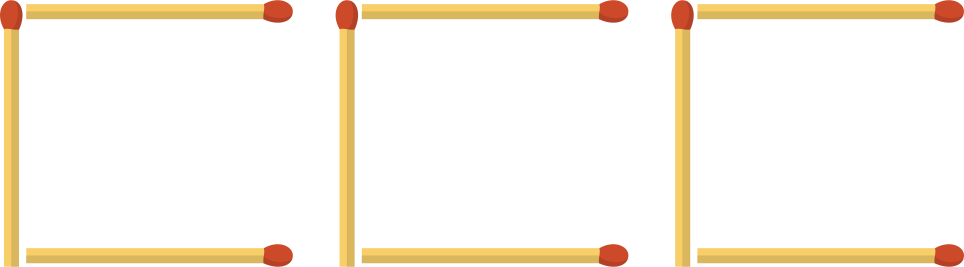
Similarly, if we need \(4C\)'s, then we need \(3 + 3 + 3 + 3 = 12\) matchsticks.
If we need \(6C\)'s, then we need \(3 + 3 + 3 + 3 + 3 + 3 = 18\) matchsticks.

Thus, we get a pattern of \(3\), \(6\), \(9\), \(12\), \(15\), \(18\), ....
We can see that the terms are multiples of \(3\).
Rule for number of matchsticks required \(= 3n\)
Where \(n\) is the number of \(C\)'s in the pattern.