

Observation
When evaluating the Highest Common Factor (HCF) of numbers like \(6\) and \(18\), we observe that:HCF(\(6\), \(18\)) = \(6\)
Here, the HCF is equal to one of the original numbers \(6\).
This property occurs whenever one number is a factor of the second number.
Important!
If \(a\) is a factor of \(b\), then \(b\) is automatically a multiple of \(a\).
When we observe a mathematical property or pattern that holds true across all possible cases, we formulate a general statement. This process of mathematical reasoning is called generalisation.
Algebra allows us to express general statements concisely using variables:
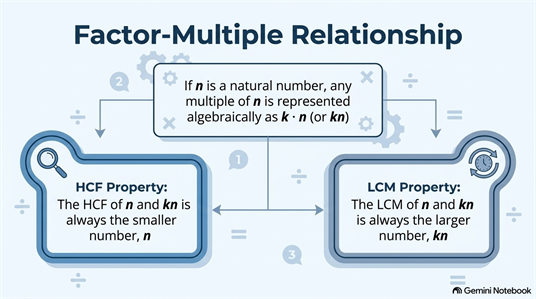
If \(n\) is a natural number, any multiple of \(n\) can be represented algebraically as \(k · n\) (or \(kn\)), where \(k\) is a positive integer.
Here, \(n\) is a factor of \(kn\), and \(kn\) is a multiple of \(n\).
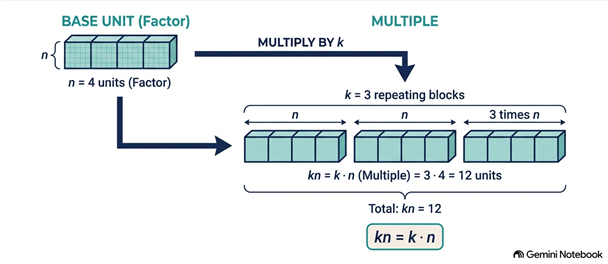
For any positive integers \(n\) and \(kn\):
1. Highest Common Factor (HCF): The HCF of \(n\) and \(kn\) is always the smaller number, \(n\).
HCF(\(n\), \(kn\)) = \(n\)
Example:
HCF(\(6\),\(18\)) = \(6\) and HCF(\(n\), \(5n\)) = \(n\).
2. Lowest Common Multiple (LCM): The LCM of \(n\) and \(kn\) is always the larger number, \(kn\).
LCM(\(n\), \(kn\)) = \(kn\)
Example:
LCM(\(3\), \(24\)) = \(24\).
Example
For number pairs satisfying this property (i.e., one of the numbers is the HCF), If one number is \(m\), what could be the other number?
Solution:
If one number is the HCF of two numbers, the other number must be a multiple of the HCF.
Let \(m\) be the HCF of the two numbers.
The other number can be any positive integer multiple of \(m\).
Therefore, the other number can be written as \(km\) where \(k\) is a positive integer.
Example:
Let \(m=5\) and \(k=3\).
The two numbers are \(5\) and \(15\).
The factors of \(5\) are \(1,5\).
The factors of \(15\) are \(1,3,5,15\).
Hence, HCF (\(5\), \(15\)) = \(5\).
Thus, \(m\) is the HCF of \(m\) and \(km\).