

Property Involving both the HCF and the LCM
Which is greater — the LCM of two numbers or their product?
For any two positive integers \(a\) and \(b\), their product \(a \times b\) is divisible by \(a\) (since \(\frac{a×b}{a} = b\)) and also divisible by \(b\) (since \(\frac{a× b}{b} = a\)).
Therefore, \(a \times b\) is always a common multiple of \(a\) and \(b\).
By definition, the Lowest Common Multiple (LCM) is the smallest positive integer that is a common multiple of \(a\) and \(b\).
Since \(a \times b\) is one of the common multiples, the LCM cannot exceed \(a \times b\):
\(LCM(a, b) \le a \times b\)
Thus, the LCM of two numbers is never greater than their product.
When does equality hold?
\(LCM(a, b) = a \times b\) if and only if \(HCF(a, b) = 1\) (i.e., when \(a\) and \(b\) are co-prime).
If \(a\) and \(b\) share a common factor greater than \(1\), then \(LCM(a, b) \lt a \times b\)
Let us analyze the relationship between the product ,HCF, and LCM using the numbers \(105\) and \(95\).
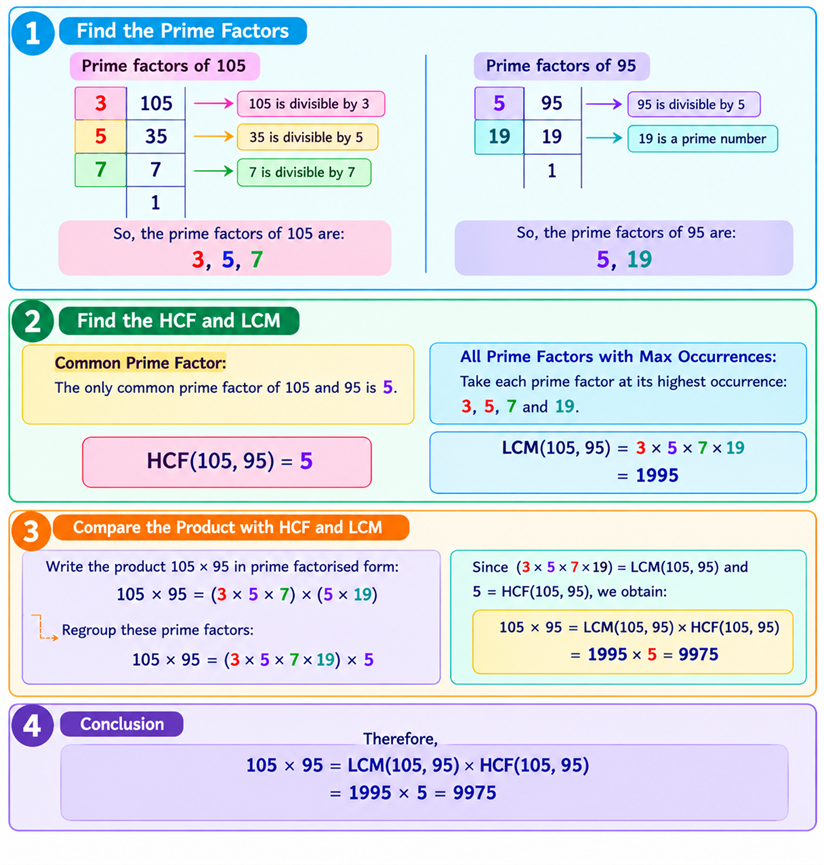
Therefore,
The product of the two given numbers is equal to the product of their HCF and LCM.
That is, \(\text{Product of two numbers} = \text{HCF} \times \text{LCM}\)
This simple property holds strictly for two numbers and does not generalize directly to three or more numbers.
Does \(HCF(a, b, c) \times LCM(a, b, c) = a \times b \times c\) hold in general?
NO!
In general, \(HCF(a,b,c) \ times LCM(a,b,c) = a \times b \times c\).
Consider the following example:
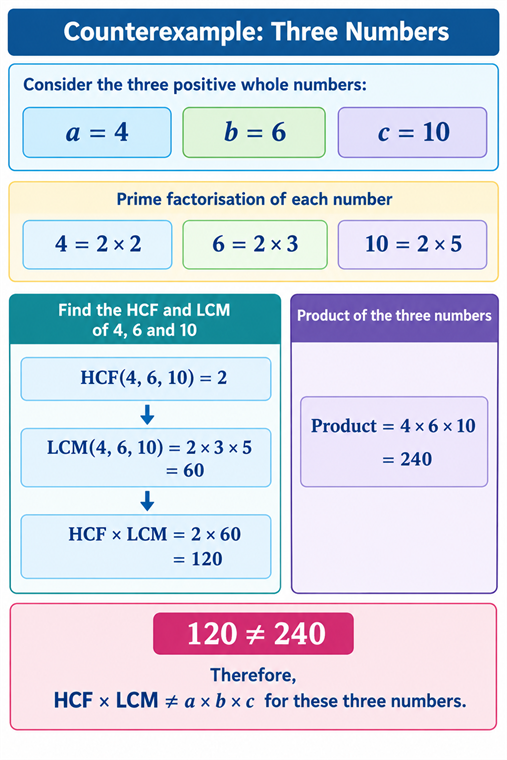
The simple identity \(HCF \times LCM = Product\) is strictly valid for two numbers only.