

The Greatest of All :
Factors and Common factors:
A factor of a number is a whole number that divides the number exactly, leaving no remainder.
For example, the factors of \(12\) are \(1, 2, 3, 4, 6\) and \(12\) because each of these numbers divides \(12\) exactly.
When two or more numbers have factors in common, those factors are called common factors.
Example: Find the common factors of \(18\) and \(24\).
-
Factors of \(18\) : \(1, 2, 3, 6, 9, 18\)
- Factors of \(24\): \(1, 2, 3, 4, 6, 8,12, 24\)
Common factors : \(1, 2, 3, 6\).
Primes :
- A prime number is a number greater than \(1\) whose only factors are \(1\) and itself.
Examples: \(2, 3, 5, 7, 11, 13\).
How can we find the prime numbers?
Can we identify all the prime numbers between \(1\) and \(100\) without checking every number individually?
Mathematicians have developed methods to make this task easier. One such method is the Sieve of Eratosthenes, named after the Greek mathematician Eratosthenes.
It helps us identify prime numbers by systematically eliminating numbers that have factors other than \(1\) and themselves.
The Sieve of Eratosthenes: A Step-by-Step Method:
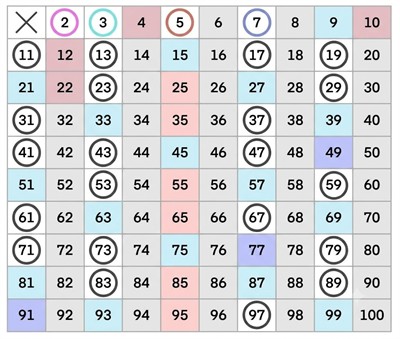
Let's discover the prime numbers \(1\) to \(100\).
Step 1: List the numbers
Write all the whole numbers from \(1\) to \(100\) in a number grid.
Step 2: Remove \(1\)
Cross out \(1\) because it is neither prime nor composite.
Step 3: Identify \(2\)
Circle \(2\). It is the smallest prime number. Cross out all its multiples greater than \(2\), such as \(4, 6, 8\) and \(10\).
Step 4: Continue with the next uncrossed number
Circle \(3\) and cross out its multiples greater than \(3\). Repeat this process for \(5, 7\) and the other uncrossed numbers.
Step 5: Identify the primes
Continue until you have checked the necessary numbers. The numbers that remain uncrossed, apart from \(1\), are prime numbers.
- A composite number is a number greater than \(1\) with more than two factors.
Examples: \(4, 9, 15, 28\).
- The number \(1\) is neither prime nor composite, because it has only one factor.
Special properties of primes:
1. The Only Even Prime Number:
The number 2 is the only even prime number.
2. Co-prime Numbers:
Two numbers are called co-prime numbers if their only common factor is \(1\).
For example, consider \(8\) and \(15\).
-
Factors of \(8\): \(1, 2, 4, 8\)
-
Factors of \(15\): \(1, 3, 5, 15\)
-
Their only common factor is \(1\).
Therefore, \(8\) and \(15\) are co-prime numbers.
3. Twin Primes:
Two prime numbers that differ by \(2\) are called twin primes.
Examples:
-
3 and 5
In each pair, both numbers are prime and their difference is \(2\).
For example, \(5 − 3 = 2\)
Hence, \(5\) and \(3\) form a pair of twin primes.
Important!
- \(2\) is the only even prime number. All other prime numbers are odd.
- Co-prime numbers need not both be prime.
For example, \(8\) and \(15\) are both composite, but they are co-prime because their only common factor is \(1\).
- Twin primes must both be prime numbers, and the difference between them must be exactly 2.
Prime factorisation :
Prime factorisation is the process of expressing a composite number as a product of prime numbers.
For example,
Consider \(60\).
We can write, \(60 = 6 \times 10\). Since \(6\) and \(10\) are composite numbers, we can factorise them futher.
\(60 = 2 \times 3 \times 2 \times 5\)
Rearranging the prime factors gives:
\(\boxed{60 = 2 \times 2 \times 3 \times 5}\)
Important!
- Every composite number can be expressed as a product of prime numbers.
- If the given number is already prime, its prime factorisation is the number itself. For example, the prime factorisation of \(13\) is simply \(13\).
The Procedure for Prime factorisation :
There are two common ways to find the prime factorisation of a number: the factor tree method and the division method.
1. Factor Tree Method :
In the factor tree method, the given number is split into two factors. Any composite factor is split again until all the final factors are prime.
Example:
Find the prime factorisation of \(36\)
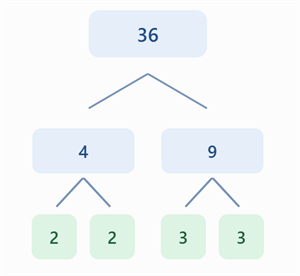
The prime factors are \(2, 2, 3\) and \(3\).
Therefore, \(\boxed{36 = 2 \times 2 \times 3 \times 3}\)
2. Division Method :
In the division method, repeatedly divide the given number by a prime number that divides it exactly. Write each quotient below the previous number. Continue until the quotient becomes \(1\).
Steps to follow in the Division Method :
- Write the given number.
- Begin with the smallest prime number that divides the given number exactly.
- Write the quotient below the previous number.
- Continue dividing by prime numbers until the quotient becomes \(1\).
- Multiply all the prime divisors used to obtain the prime factorisation.
Example:
Find the prime factorisation of \(180\).
\begin{array}{r|l}
2 & 180 \\ \hline
2 & 90 \\ \hline
3 & 45 \\ \hline
3 & 15 \\ \hline
5 & 5 \\ \hline
& 1
\end{array}
The prime divisors on the left are \(2, 2, 3, 3,\) and \(5\).
Therefore, \(\boxed{180 = 2 \times 2 \times 3 \times 3 \times 5}\)