

A school constructs two ramps for wheelchair access. Each ramp forms a right-angled triangle, with the ground as the horizontal base, the vertical rise as one perpendicular side, and the sloping ramp surface as the hypotenuse.
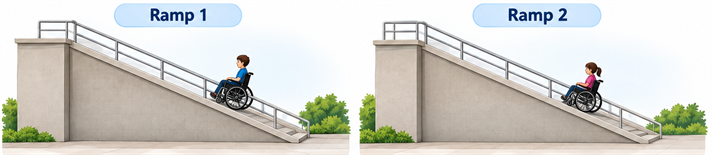
In Ramp \(1\), the sloping surface (hypotenuse) is \(10 \ m\) long, and its vertical height is \(6 \ m\).
In Ramp \(2\), the sloping surface (hypotenuse) is also \(10 \ m\) long, and its vertical height is \(6 \ m\).
Answer the following questions based on the information given.
(a) What is the angle between the two perpendicular sides (the vertical rise and the horizontal base) of each triangular ramp?
(b) The congruence condition applicable to the two ramps is:
(c) Let Ramp \(1\) be represented by \(\triangle ABC\) and Ramp \(2\) by \(\triangle DEF\). Given that: \(\angle C = \angle F = 90^\circ\), \(AB = DE = 10 \ m\), \(AC = DF = 6 \ m\)
The correct symbolic statement expressing the congruence of the two triangles is:
The correct symbolic statement expressing the congruence of the two triangles is:
(d) If the remaining (unknown) side of Ramp \(1\) is represented by \(x\) and the remaining (unknown) side of Ramp \(2\) is represented by \(y\), find the values of \(x\) and \(y\).