

Geometric Twins
Imagine you are given a placard with a custom-designed checkmark symbol and asked to create an exact copy on another board. How can you recreate this figure accurately? While you could use tracing paper to copy the outline, this becomes highly impractical for large outdoor placards. Instead, we can use geometric measurements to replicate the shape.

Let us name the corner points of this symbol as \(P\), \(Q\), and \(R\), as shown in the figure below:
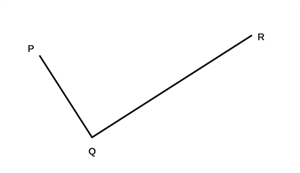
where \(Q\) represents the vertex connecting the two arms.
Are the arm lengths \(PQ\) and \(QR\) sufficient to guarantee an exact recreation?
Example
Suppose we measure \(PQ = 5 \ cm\) and \(QR = 10 \ cm\).
If we only use these lengths, we can construct several completely different-looking symbols with those exact arm lengths, as seen in the diagram below:
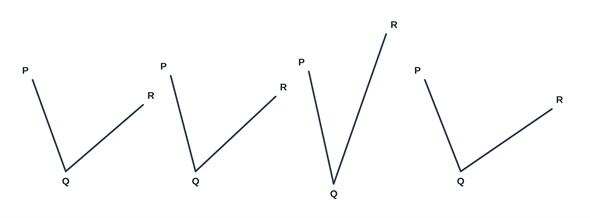
To fix the exact shape and size of the figure, we must measure the angle formed between the arms: \(\angle \ PQR\).
Therefore, the two arm lengths and the included angle fix the figure uniquely, allowing us to build an exact copy.
Figures that are exact copies of each other (or) have the same shape and size are defined as congruent.
Important!
A key property of congruent figures is that they can be superimposed exactly so that one fits over the other.
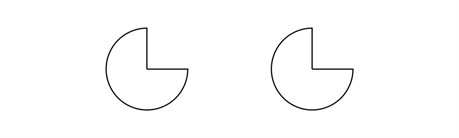
The two figures shown below are congruent. Since you could use tracing paper to trace the first figure and superimpose it on the second, then you will find that they fit exactly, one over the other.
Note:
While verifying congruence, a figure can be rotated or flipped before superimposing it on the other. So, the following pairs of figures are also congruent to each other.
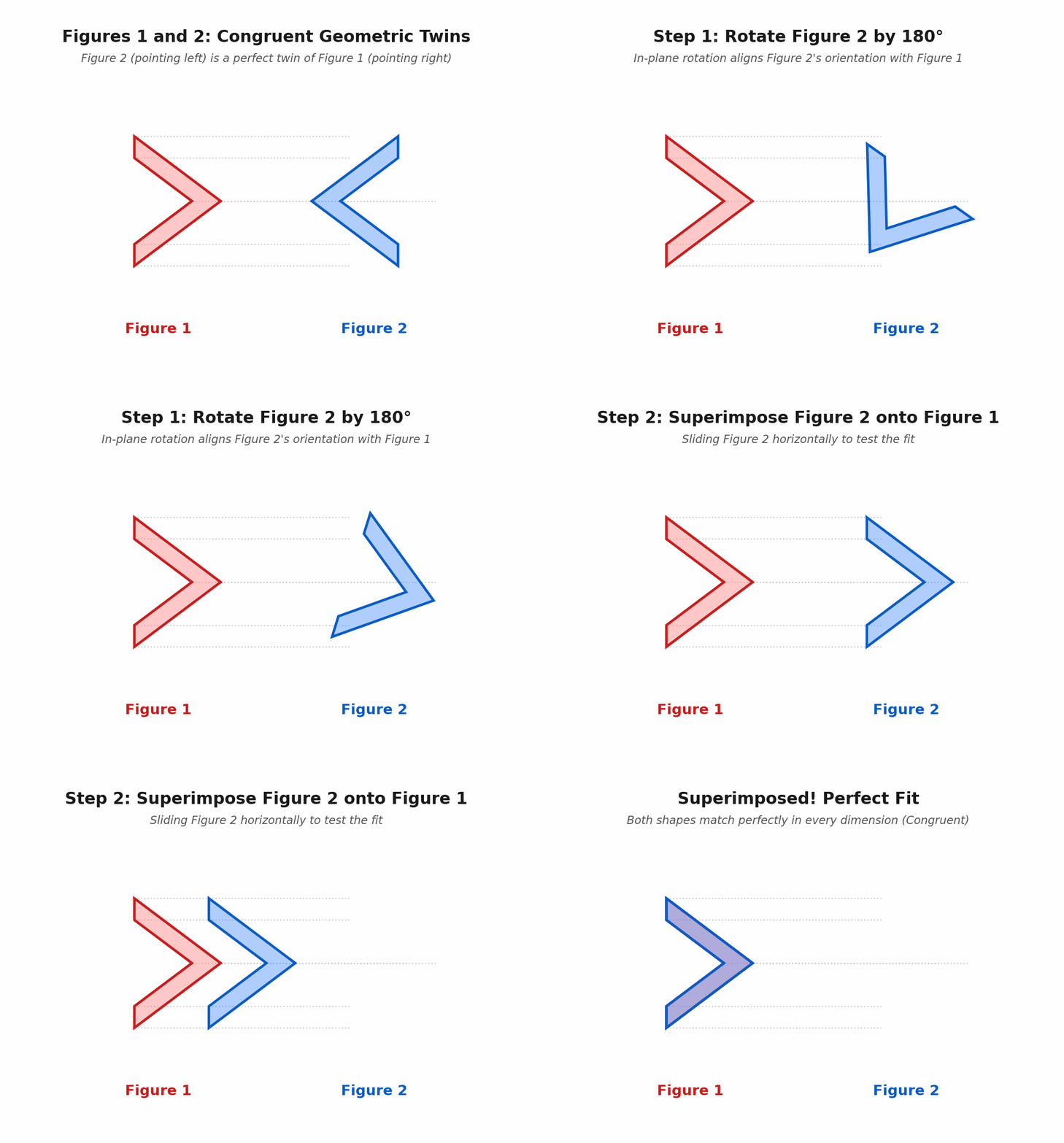
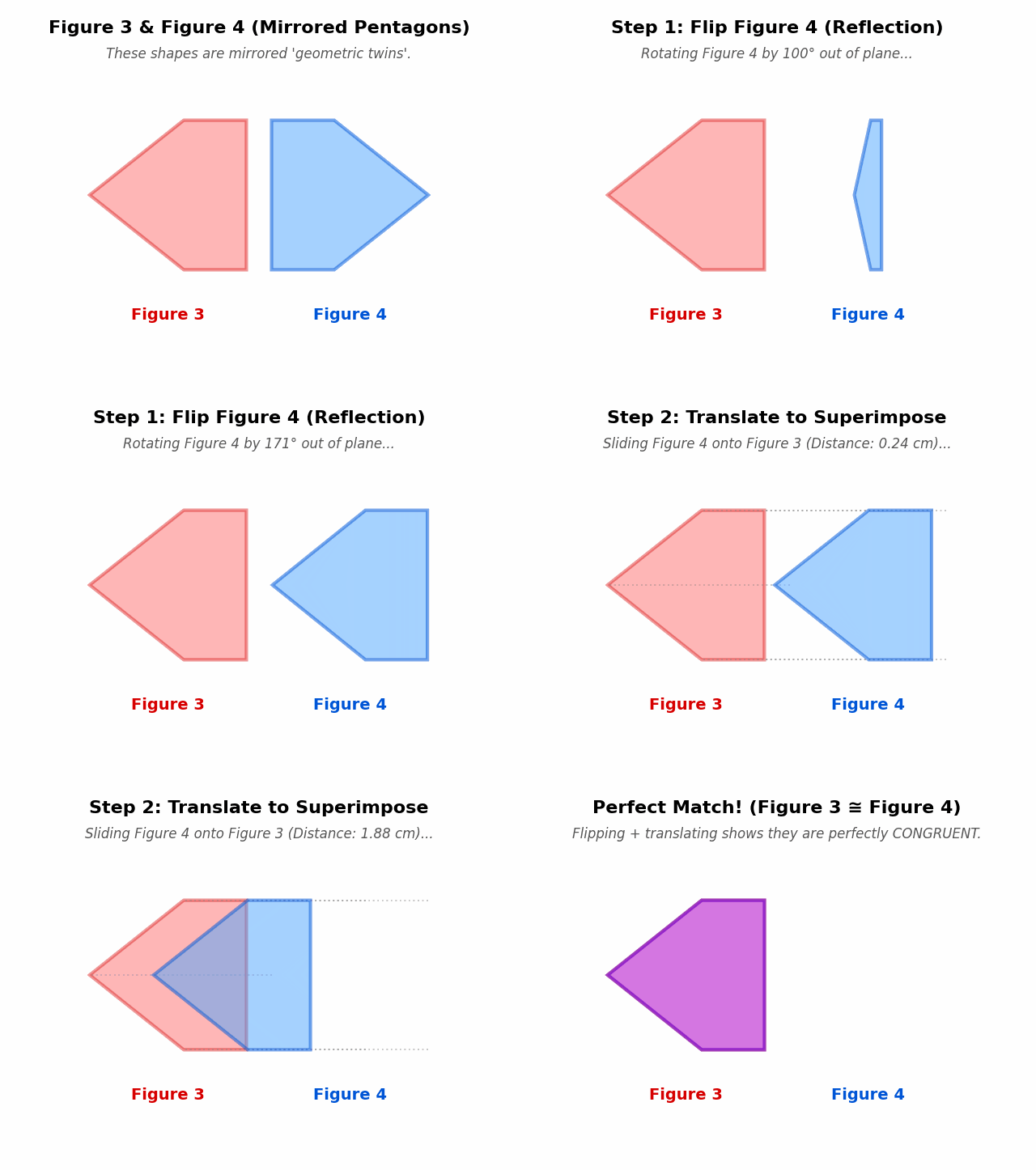
The first figure is rotated and becomes congruent, while the second figure is flipped and becomes congruent.
Let's return to the symbol that was displayed on the placard. Suppose two such symbols that have the same appearance and we need to verify that they are congruent. Is it possible to confirm this using their measurements?
No, it remains congruent if its side lengths \(PQ\), \(QR\) and included angle \(\angle \ PQR\) are equal.
Congruence of Triangles
Congruence of a triangle:
Two triangles are congruent if
(i) their corresponding sides are equal in length and
(ii) their corresponding angles are equal in measure.
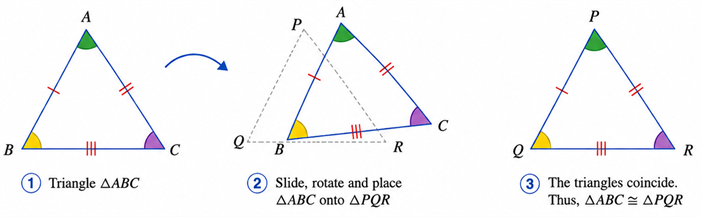
That is, if the two triangles are superimposed on each other, their sides and angles will coincide.
Conventions to Express Congruence
When two triangles are congruent, their corresponding vertices, sides, and angles must overlap exactly. Suppose we have two congruent triangles, \(\Delta DEF\) and \(\Delta PQR\),
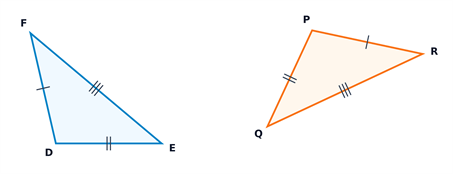
where Vertex \(D\) overlaps with Vertex \(P\), Vertex \(E\) with Vertex \(Q\), and Vertex \(F\) with Vertex \(R\). The following table provides a summary of this exact structural correspondence:
| Geometric Element | \(\Delta DEF\) Element | \(\Delta PQR\) Element | Correspondence Details |
| Corresponding Vertices |
\(D\), \(E\), \(F\) | \(P\), \(Q\), \(R\) | \(D \leftrightarrow P\), \(E \leftrightarrow Q\), \(F \leftrightarrow R\) |
| Corresponding Sides | \(DE\), \(EF\), \(DF\) | \(PQ\), \(QR\), \(PR\) | \(DE = PQ\), \(EF = QR\), \(DF = PR\) |
| Corresponding Angles | \(\angle D\), \(\angle E\), \(\angle F\) | \(\angle P\), \(\angle Q\), \(\angle R\) |
\(\angle D = \angle P\), \(\angle E = \angle Q\), \(\angle F = \angle R\)
|
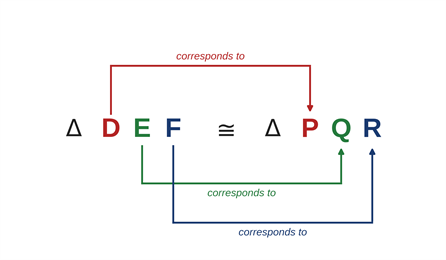
To capture this relation, the congruence is written as: \(\Delta DEF \cong \Delta PQR\).
Important!
The order of vertices in the name of the first triangle must correspond exactly to the order of vertices in the name of the second triangle.
• Incorrect Notation: It is mathematically incorrect to write \(\Delta DFE \cong \Delta PQR\) because this order claims that Vertex \(F\) corresponds to Vertex \(Q\), which violates the structural mapping (\(F\) overlaps with \(R\)).
• Correct Alternatives: We can write the congruence in other correct ways by preserving the exact relative ordering of corresponding vertices, such as \(\Delta DFE \cong \Delta PRQ\) (or) \(\Delta EFD \cong \Delta QRP\).
Example
Consider the two triangles \(ABC\) and \(PQR\) as given below:
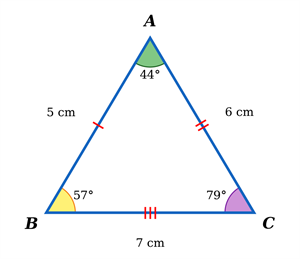
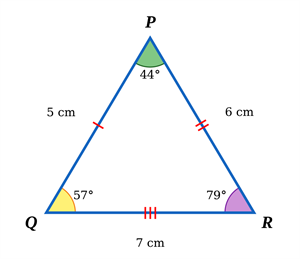
Corresponding Sides:
\(AB = PQ = 5 \ cm\)
\(AC = PR = 6 \ cm\)
\(BC = QR = 7 \ cm\)
Corresponding Angles:
\(\angle A = \angle P = \)
\(\angle B = \angle Q = \)
\(\angle C = \angle R = \)
Hence, the two triangles \(ABC\) and \(PQR\) are congruent.
Superimposition: If \(\Delta ABC\) is superimposed on \(\Delta PQR\), their sides and angles coincide as shown in the diagram below.
Important!
In congruent triangles, corresponding parts are equal, and we write in short 'CPCT' for corresponding parts of congruent triangles.
SSS (Side Side Side) congruence condition
Consider a scenario involving two friends, Diya and Sam, who are tasked with making a paper cutout replicated to a large triangular framed mirror in their house.

The frame is too large to be directly traced on paper. So they use a measuring tape to capture its measurements. The cousins measure the three side lengths of the frame to be \(50 \ cm\), \(70 \ cm\), and \(90 \ cm\).
Diya then prepares to take out her protractor to measure the interior angles, but is stopped by Sam, who states: "The angles of the triangle are not required! With the side lengths we have measured, we can create a triangle congruent to this one."
To test Sam's prediction, let us scale down the side lengths to \(5 \ cm\), \(7 \ cm\), and \(9 \ cm\) so that the triangle fits on a standard page. Diya proposes a systematic ruler-and-compass construction:
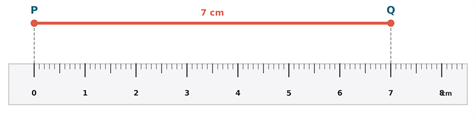
Step 1: Draw a base line segment \(PQ\) of length \(7 cm\).
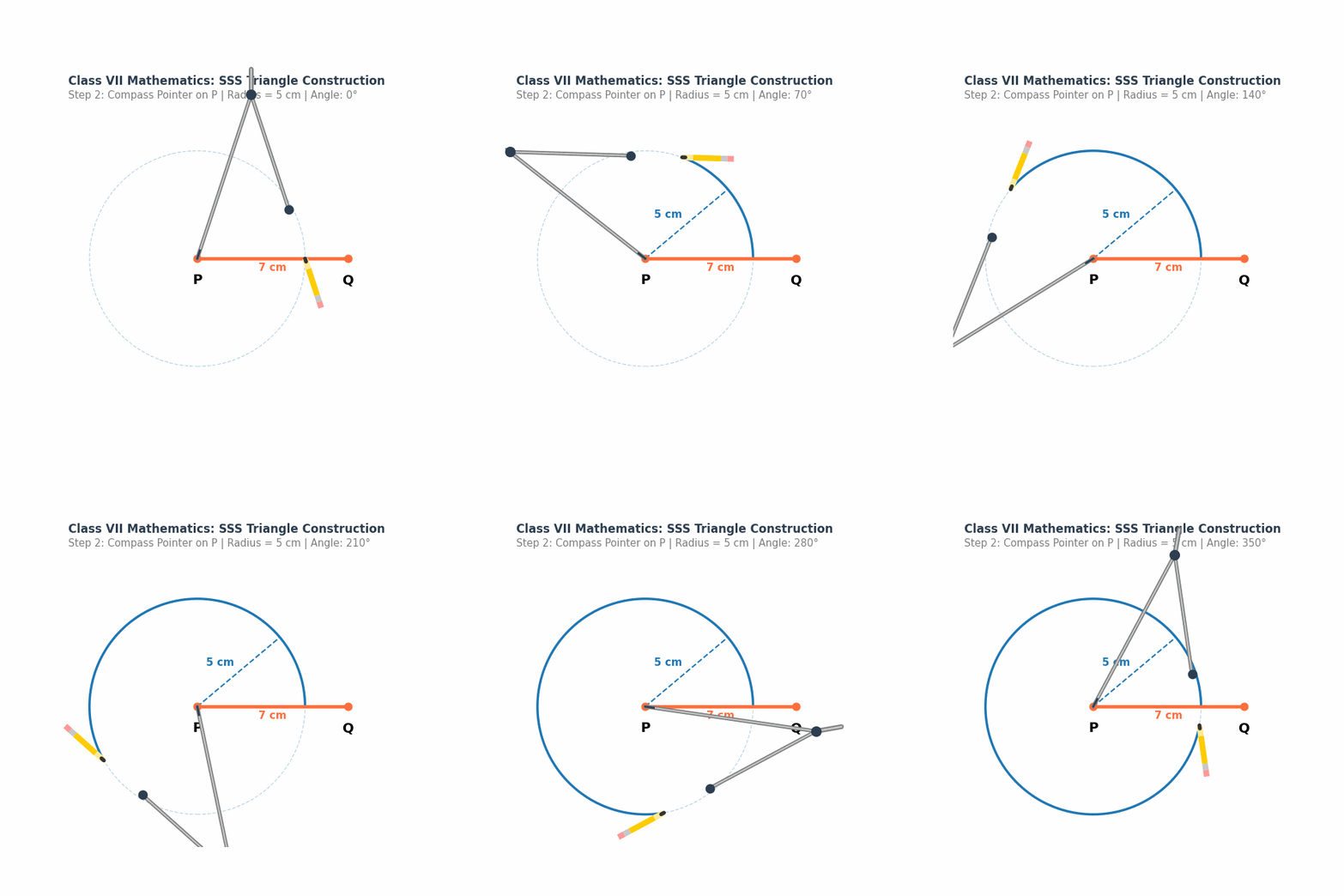
Step 2: Draw a circle (or arc) with centre \(P\) and radius \(5 \ cm\).
Step 3: Draw a circle (or arc) with centre \(Q\) and radius \(9 \ cm\).
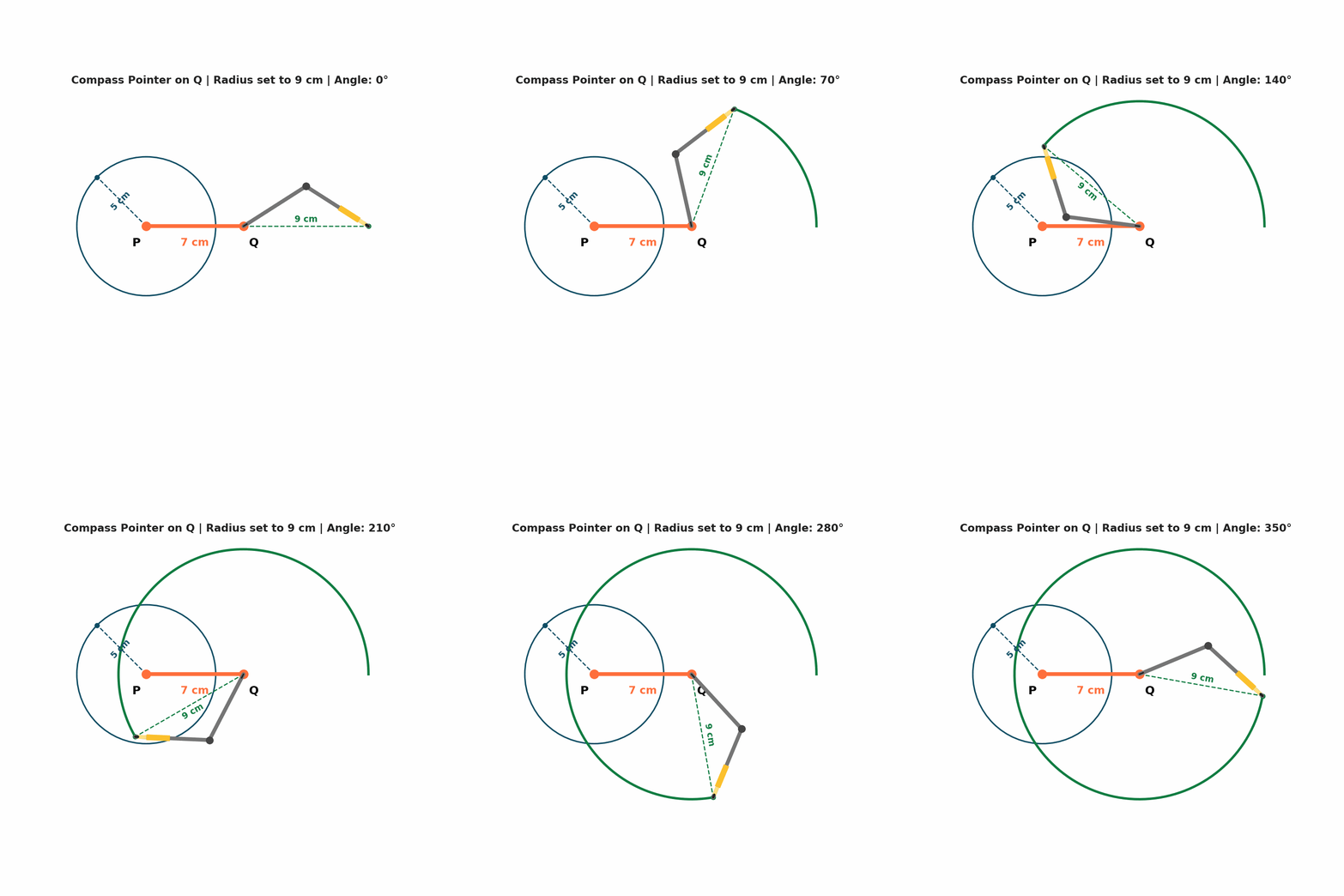
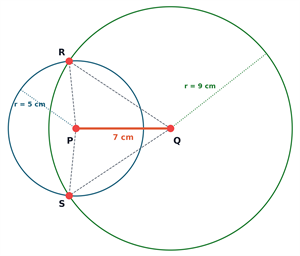
The circles intersect at exactly two points: point \(R\) (above the base line segment \(PQ\)) and point \(S\) (below the base line). This forms two triangles: \(\Delta PQR\) and \(\Delta PQS\).
Do \(\Delta PQR\) and \(\Delta PQS\) have the same shape and size? To check, we can fold our construction paper along the base line \(PQ\) and superimpose one triangle over the other. We find that \(\Delta PQR\) fits exactly over \(\Delta PQS\). This is because the segment \(PQ\) acts as a line of symmetry due to the mathematical identity of the ruler-and-compass construction above and below the base line.
Hence \(\Delta PQR\) and \(\Delta PQS\) are congruent. This generic construction shows that all triangles with the same side lengths are congruent. Thus the result is as follows:
SSS (Side Side Side) congruence condition:
If two triangles have the same sidelengths, then they are congruent.
Example
Consider two triangles \(\Delta XYZ\) and \(\Delta RPQ\).
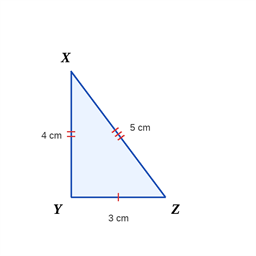
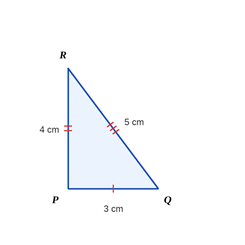
Step 1: Compare the corresponding sides
From the figure,
\(YZ = PQ = 3 \ cm\)
\(XY = RP = 4 \ cm\)
\(XZ = RQ = 5 \ cm\)
Step 2: Check the SSS congruence condition
All three corresponding sides of the two triangles are equal.
Therefore, by the SSS (Side Side Side) congruence condition, the two triangles are congruent.
Step 3: Identify the correspondence
To express triangles in terms of congruence notation, we need to identify the corresponding vertices.
The corresponding vertices are:
\(X \leftrightarrow R\)
\(Y \leftrightarrow P\)
\(Z \leftrightarrow Q\)
Hence \(\Delta XYZ \cong \Delta RPQ\)