

In the previous section, we have seen that measuring the three sides of a triangle is enough to construct a triangle congruent to a given triangle.
Measuring the Angles
Can we recreate a triangle exactly if we only measure its three angles? Suppose we measure the angles of a triangular frame to be \(40 ^\circ\), \(60 ^\circ\) and \(80 ^\circ\). We can construct many triangles having angles \(40 ^\circ\), \(60 ^\circ\) and \(80 ^\circ\) with different side lengths, as shown in the diagram below
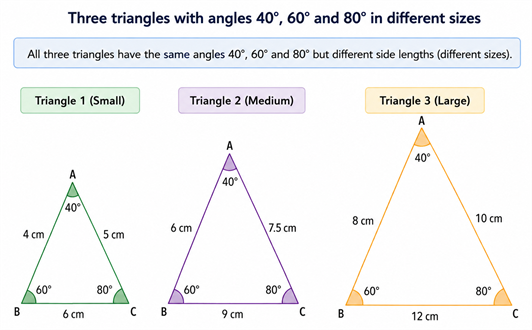
These triangles have the same shape but different sizes. Therefore, two triangles with the same set of angles need not be congruent because they cannot be superimposed perfectly over each other. Thus, the AAA (Angle-Angle-Angle) condition does not guarantee congruence.
Important!
Angles can determine the shape of a triangle, but they do not necessarily determine its size.
So, AAA (Angle Angle Angle) is not a congruence condition.
SAS Congruence Condition
We have seen that three sides are sufficient to establish congruence. We have also seen that three angles are not sufficient.
Now let us consider another situation:
What happens if we know two sides and the angle between them?
Consider two triangles, \(\Delta ABC\) and \(\Delta PQR\), as shown in the figure.
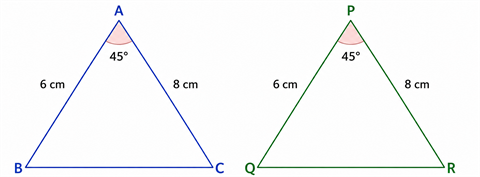
From the figure,
\(AB = PQ = 6 \ cm\)
\(AC = PR = 8 \ cm\)
\(\angle A = \angle P = 45^\circ\)
In \(\Delta ABC\), the sides \(AB\) and \(AC\) meet at \(\angle A\).
Similarly, in \(\Delta PQR\), the sides \(PQ\) and \(PR\) meet at \(\angle P\).
Here, the two given sides meet at the given angle.
Therefore, the given angle is called the included angle.
The included angle is the angle formed by the two given sides.
(i.e) In \(\Delta ABC\), \(\angle A\) is the included angle between \(AB\) and \(AC\).
In \(\Delta PQR\), \(\angle P\) is the included angle between \(PQ\) and \(PR\).
Important!
It would not be correct to use \(\angle B\) or \(\angle C\) as the included angle for the two sides \(AB\) and \(AC\) in \(\Delta ABC\).
Here, \(\Delta ABC\) and \(\Delta PQR\) have the same two side lengths and included angle, so they are the same shape and size.
Thus, the two triangles will fit exactly over one another when superimposed.
Therefore:
When two sides and the included angle of two triangles are equal, the two triangles are congruent. This is referred to as the SAS (Side Angle Side) condition for congruence.
Example
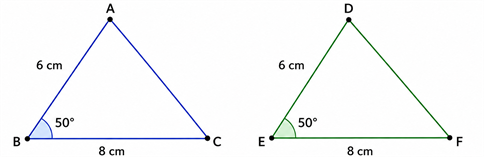
Consider two triangles, \(\Delta ABC\) and \(\Delta PQR\), as shown in the figure.
Check whether the two triangles are congruent.
Solution:
From the figure,
In \(\Delta ABC\), \(AB = 6 \ cm\), \(BC = 8 \ cm\) and \(\angle B = 50^{\circ}\)
In \(\Delta DEF\), \(DE = 6 \ cm\), \(EF = 8 \ cm\) and \(\angle E = 50^{\circ}\)
Here, \(\angle B\) is the angle between \(AB\) and \(BC\), and \(\angle E\) is the angle between \(DE\) and \(EF\). Therefore, both are included angles.
Thus, we have:
\(AB = DE = 6 \ cm\) (One side equal)
\(\angle B = \angle E = 50^{\circ}\) (Included angle equal)
\(BC = EF = 8 \ cm\) (Second Side equal)
We have two corresponding sides and the included angle equal.
By the SAS congruence condition, the two triangles are congruent.
As we need \(AB\) and \(DE\) to overlap, and \(BC\) and \(EF\) to overlap for the triangles to exactly fit over each other, the corresponding vertices in \(\Delta ABC\) and \(\Delta DEF\) are
\(A\) and \(D\),
\(B\) and \(E\), and
\(C\) and \(F\).
Thus \(\Delta ABC \cong \Delta DEF\)
Triangle construction