

A school creates two triangular flower beds. The students measure the sides and an angle of each flower bed.
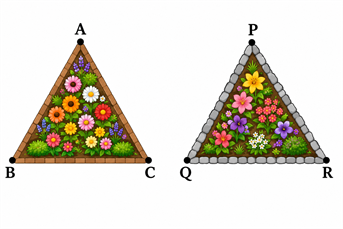
For \(\triangle ABC\):
\(AB = 10 \ m, BC = 6.1 \ m, \angle B = 70^\circ\)
For \(\triangle PQR\):
\(PQ = 10 \ m, QR = 6.1 \ m, \angle Q = 70^\circ\)
The school gardener wants to check whether both flower beds are congruent.
Based on the above information, answer the questions below.
Questions:
1. Which of the following represents the two pairs of corresponding sides?
2. Which of the following pairs represents the corresponding angles?
3. Complete the statement:
\(AB = PQ\), \(BC = QR\) and \(\angle B = \angle Q \)
Therefore, \( \triangle ABC \cong \triangle PQR \) by the .......... Congruence Condition.
\(AB = PQ\), \(BC = QR\) and \(\angle B = \angle Q \)
Therefore, \( \triangle ABC \cong \triangle PQR \) by the .......... Congruence Condition.
4. If \(AC = 8.7 \ m\), what is the length of \(PR\)?