

A system of numeration is a system for expressing numbers with the help of digits in a consistent manner.
There are two types of number system:
- Indian numeral system (Hindu-Arabic number system)
- International numeral system
What is the Indian numeral system?
This system was invented between the \(1st\) and \(3rd\) centuries by Indian mathematicians. The system was adopted in Arabic mathematics by the \(9th\) century, and then it came to known as the Hindu-Arabic system. The system later spread to Europe. It is the most widely used system of numerals.
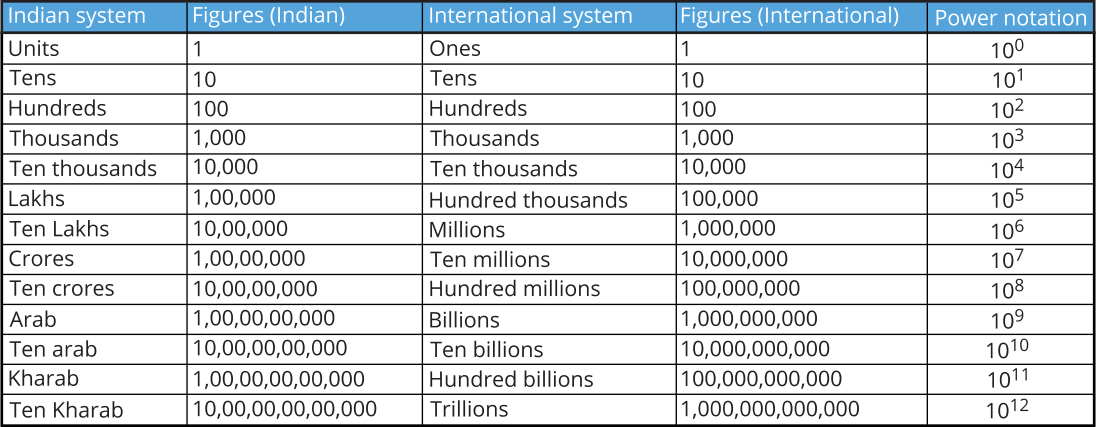
The place values of digits are Ones, Tens, Hundreds, Thousands, Ten Thousands, Lakhs, Ten Lakhs, Crores, and so on.
Let us go through the Indian numeral system place value table:
Periods on Ones:
| Place value | Hundreds | Tens | Ones |
| Number | \(100\) | \(10\) | \(1\) |
| Number of zeros | \(2\) | \(1\) | \(0\) |
Periods on Thousands:
| Place value | Ten Thousands | Thousands |
| Number | \(10000\) | \(1000\) |
| Number of zeros | \(4\) | \(3\) |
Periods on Lakhs:
| Place value | Ten Lakhs | Lakhs |
| Number | \(1000000\) | \(100000\) |
| Number of zeros | \(6\) | \(5\) |
Periods on Crores:
| Place value | Ten Crore | Crore |
| Number | \(100000000\) | \(10000000\) |
| Number of zeros | \(8\) | \(7\) |
International numbering system:
The International number system is another method for representing numbers.
In International numbering system, to read the numbers easily different periods are formed. The periods used here are ones, thousand and millions etc.
The place values in the International system of numeration are Ones, Tens, Hundreds, Thousands, Ten Thousands, Hundred Thousands, Millions, Ten millions, and so on.
Let us go through the International numeral system place value tables:
Periods on Ones:
| Place value | Hundreds | Tens | Ones |
| Number | \(100\) | \(10\) | \(1\) |
| Number of zeros | \(2\) | \(1\) | \(0\) |
Periods on Thousands:
| Place value | Hundred Thousands | Ten Thousands | Thousands |
| Number | \(100000\) | \(10000\) | \(1000\) |
| Number of zeros | \(5\) | \(4\) | \(3\) |
Periods on Millions:
| Place value | Hundred Million | Ten Million | Million |
| Number | \(100000000\) | \(100000000\) | \(1000000\) |
| Number of zeros | \(8\) | \(7\) | \(6\) |
Periods on Billions:
| Place value | Hundred Billion | Ten Billion | Billion |
| Number | \(100000000000\) | \(10000000000\) | \(1000000000\) |
| Number of zeros | \(11\) | \(10\) | \(9\) |
Periods on Trillions:
| Place value | Hundred Trillion | Ten Trillion | Trillion |
| Number | \(100000000000000\) | \(10000000000000\) | \(1000000000000\) |
| Number of zeros | \(14\) | \(13\) | \(12\) |
Numbers can be expressed in three forms. They are as follows:
- Standard form
- Expanded form
- Written form
Standard form: The standard form is nothing but the mathematical form of the number.
Example:
The number \(425\) - Standard form.
Similarly, \(8756, 369824, 587469123\) are also the standard forms of numbers
Expanded form: Split a number according to their place value and expand it to show the value of each digit is called the expanded form.
Example:
For the same set of numbers \(425, 8756, 369824, 587469123\), the expanded form will be as follows:
Written form: This can be done by directly converting the expanded form to words.
Example:
For the same set of numbers \(425, 8756, 369824, 587469123\), all the three forms are listed below.
|
Standard form
|
Expanded form
|
Written form (Indian system)
|
Written form (International system)
|
| \(425\) | \(400+20+5\) | Four Hundred Twenty-Five | Four Hundred Twenty-Five |
Important!
\(10\) lakhs \(=\) \(1\) million
\(1\) crore \(=\) \(10\) million
\(100\) crores \(=\) \(1\) billion