

Virahāṅka–Fibonacci Sequence
The sequence \(1\), \(2\), \(3\), \(5\), \(8\), \(13\), \(21\), \(34\), \(55\), .... is called the Virahāṅka–Fibonacci sequence. It is one of the most famous number patterns in mathematics and appears in art, music, architecture, science, and nature.
Although it is widely known as the Fibonacci sequence, this pattern was discovered centuries earlier in India by the scholar Virahāṅka while studying the rhythm of poetry.
Although it is widely known as the Fibonacci sequence, this pattern was discovered centuries earlier in India by the scholar Virahāṅka while studying the rhythm of poetry.
How Was the Sequence Discovered?
Thousands of years ago, Indian scholars studied poems written in languages such as Prakrit, Sanskrit, Tamil, Telugu, Marathi, and Malayalam. In these poems:
- A short syllable takes \(1\) beat of time.
- A long syllable takes \(2\) beats of time.
This leads to numerous mathematical questions, which the ancient poets in these languages considered extensively.
In how many different ways can a rhythm of a given number of beats be formed using short (\(1\) beat) and long (\(2\) beats) syllables?
This question led to the discovery of the Virahāṅka sequence.
Understanding the Pattern
Instead of listing every possible rhythm, we can use a simple pattern. Suppose we want to find the number of ways to make \(8\) beats with short and long syllables.
\(\Rightarrow\) long long long long
\(\Rightarrow\) short short short short short short short short
\(\Rightarrow\) short long long short long
\(\Rightarrow\) long long short short long
\(\Rightarrow\) short short short short short short short short
\(\Rightarrow\) short long long short long
\(\Rightarrow\) long long short short long
...
Let us see this more mathematically.
Writing a Number as the Sum of 1's and 2's
The same idea can be understood mathematically by writing a number as the sum of \(1\)'s and \(2\)'s in all possible ways.
Different ways of writing numbers
| Different Ways | Number of Ways | |
| \(n = 1\) | \(1\) | \(1\) |
| \(n = 2\) |
\(1 + 1\)
\(2\)
|
\(2\) |
| \(n = 3\) |
\(1 + 1 + 1\)
\(1 + 2\)
\(2 + 1\)
|
\(3\) |
| \(n = 4\) |
\(1 + 1 + 1 + 1\)
\(1 + 1 + 2\)
\(1 + 2 + 1\)
\(2 + 1 + 1\)
\(2 + 2\)
|
\(5\) |
Notice the pattern in the Number of Ways column:
This gives the sequence \(1\), \(2\), \(3\), \(5\), \(8\), ...
This sequence is called a Virahanka Sequence.
Rule for Virahanka Numbers: Each number is obtained by adding the two previous numbers.
History of the Sequence
Around \(700 CE\), Virahāṅka, a Prakrit scholar, first described this sequence while studying poetic rhythms. Later, scholars such as Gopala and Hemachandra also studied and extended these ideas.
About \(500\) years later, the Italian mathematician Leonardo Fibonacci introduced the same sequence in Europe. Hence, it is also known as the Fibonacci Sequence.
Virahāṅka Numbers in Nature
Virahāṅka numbers appear in many places around us, especially in nature.
How many petals do you see on each of these flowers?
How many petals do you see on each of these flowers?
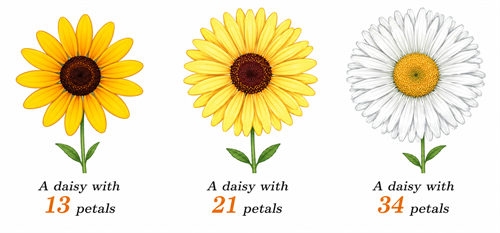
Daisy flowers often have \(13\), \(21\), or \(34\) petals. They appear in the arrangement of leaves and seeds.
There are many other remarkable mathematical properties of the Virahāṅka–Fibonacci numbers that we will see later, in mathematics as well as in other subjects.