The Grid and the Rule
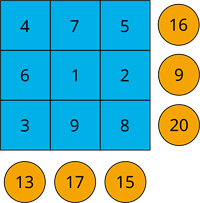
- We have a \(3 \times 3 \ \) grid.
- We fill it with numbers \(1\) to \(9 \ \) without repeating.
- Yellow circles outside the grid show the sum of each row or column.
Example: If the first row is \(4\), \(7\), \(5\), its sum is \(4 + 7 + 5 = 16\). So, '\(16\)' is written outside.
Filling the Grid
If we know the sums for rows and columns, we can fill missing numbers by:
- Making sure there are no repeating numbers.
- Making sure each row and column matches the sum given outside.
Why Row Sums and Column Sums Add to \(45\)?
- Numbers \(1\) to \(9\) add up to \(45\)
\(1 + 2 + 3 + ... + 8 + 9 = 45\)
- Since all \(9\) numbers appear exactly once in the grid:
- Adding all row sums together \(= 45\)
- Adding all column sums together \(= 45\)
- This is always true for any \(3 \times 3\) grid using \(1 - 9\).
Magic square - \(3 \times 3\)
A magic square is a grid with numbers arranged so the row, column, and diagonal sums are all the same. In a \(3×3\) magic square with numbers \(1 - 9\), the magic sum is always \(15\).
Which Numbers Can Be in the Centre?
The middle number is a part of \(4\) lines (row, column, and \(2\) diagonals).
So, only \(5\) works in the centre.
Why do \(9 \) or \(1\) not work in the centre?
If center equals \(9\), you'd need a row like \(9 + 8 +\) another number \(= 15\), which is not possible.
Similarly, \(1 + 2 +\) another number \(= 15\), which is not possible.
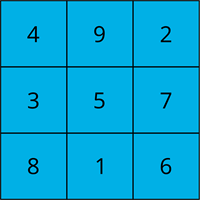
Arranging Numbers:
- \(1\) and \(9\) cannot be in a corner in a magic square. They must be in the middle of an edge.
- \(5\) is always in the centre of the grid.
- Opposite cells always add to \(10\) (e.g. \(2 \ \& \ 8\), \(3 \ \& \ 7\))
- Each row, column, and diagonal totals \(15\).
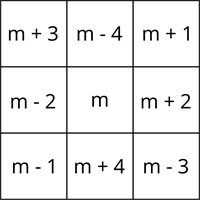
General form of \(3 \times 3\) magic square:
Let the centre of the grid be \(m\).
A \(3 \times 3\) magic square built from consecutive numbers has this pattern relative to the centre.
Magic Square - \(4 \times 4\)
We know about the \(3 \times 3\) magic square that the sum of the numbers in each row, each column, and both diagonals is the same. This is also applicable to a \(4 \times 4\) magic square. The first ever recorded \(4 \times 4\) magic square is found in a \(10\)th century inscription at the Pārśhvanath Jain temple in Khajuraho, India, and is known as the Chautīsā Yantra.
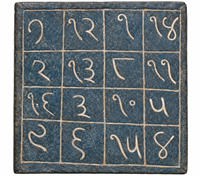 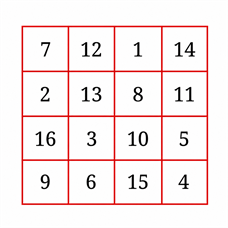 |
| The first ever recorded \(4 \times 4\) magic square, the Chautīsā Yantra, at Khajuraho, India |
Chau̐tīs means \(34\). Every row, column and diagonal in this magic square adds up to \(34\). Thus, the magic sum of \(4 \times 4\) square is \(34\).
Magic Squares in History and Culture
Magic squares have fascinated people for thousands of years. The earliest recorded \(3 × 3\) magic square, called the Lo Shu Square, originated in ancient China over \(2000\) years ago. It uses the numbers \(1\) to \(9\), arranged so that every row, column, and diagonal has the same sum.
Indian mathematicians made significant contributions to the study of magic squares. They developed methods for constructing magic squares of different sizes, including \(3 × 3\), \(4 × 4\), \(5 × 5\), and larger grids.
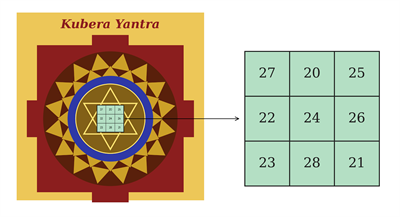
Magic squares are not only mathematical puzzles but also appear in Indian art, temples, homes, and cultural traditions. Examples include the Navagraha Yantra, where each graha (planet) has a magic square with its own magic sum, and the Kubera Yantra, which is traditionally associated with prosperity.
\(3 × 3\) magic squares can also be found in homes and shops in India. The Navagraha Yantra is one such example shown below.
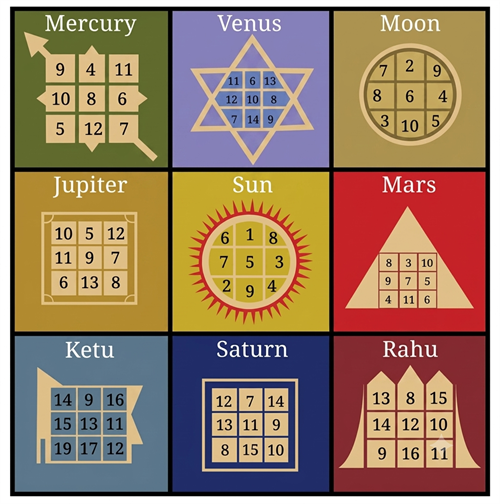
Notice that a different magic sum is associated with each graha. A picture of a Kubera Yantra is shown below: