

Number Play is like a secret code game with numbers!
Follow a simple rule, and the numbers reveal a hidden trick.
Let us see a sample of this.
A group of children decided to play a new game. They lined up in a row, tallest to shortest, all mixed up, and each child had to shout out a special secret number.
Follow a simple rule, and the numbers reveal a hidden trick.
Let us see a sample of this.
A group of children decided to play a new game. They lined up in a row, tallest to shortest, all mixed up, and each child had to shout out a special secret number.
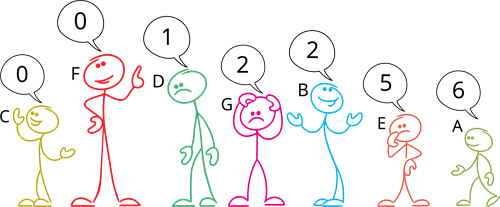
What secret are these numbers trying to share?
Every child looked only at the children standing in front of them in the line.
They counted how many of those children were taller than they were.
That count became their secret number.
They counted how many of those children were taller than they were.
That count became their secret number.
Now, the children then rearranged themselves in a different order and played again.
"Will their secret number change if they stand in a different place?"
Let us check.
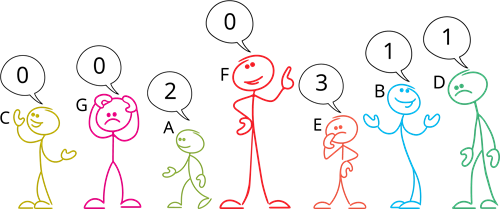
Yes, the secret number has changed.
This is because it is not about how tall they are, but how tall they are compared to the people in front of them.
What is Parity?
Parity tells us if a number is even or odd.
- Even Number: A number that is exactly divisible by \(2\).
Example: \(2\), \(8\), \(16\), \(40\)
- Odd Number: A number that is not exactly divisible by \(2\).
Example: \(3\), \(9\), \(17\), \(45\)
Think in Pairs!
A simple way to understand parity is by making pairs.
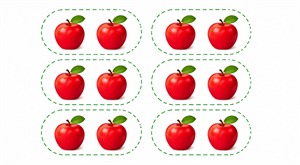
Even numbers:
Every object can be paired. No object is left alone.
Odd numbers:
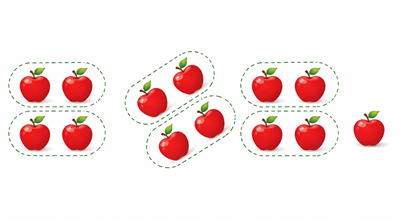
Objects can be paired. But one object is always left without a partner.
Applying Parity:
Instead of finding the exact answer, we can often decide whether the answer is even or odd. This is called applying parity.
For example,
Is the sum of five odd numbers even or odd?
Rather than adding all five numbers, we use the parity rule.
Since an odd number of odd numbers always gives an odd sum, the answer is odd.
Now, let us see the parity rules:
Addition of Parity:
odd \(+\) odd \(=\) even
even \(+\) even \(=\) even
odd \(+\) even \(=\) odd
Subtraction of Parity:
odd \(-\) odd \(=\) even
even \(-\) even \(=\) even
odd \(-\) even \(=\) odd
Product of Parity:
odd \(\times\) even \(=\) even
odd \(\times\) odd \(=\) odd
even \(\times\) even \(=\) even
Finding the \(n^{\text{th}}\) Even Number and \(n^{\text{th}}\) Odd Number
\(n^{\text{th}}\) Even number:
| Position \((n)\) | \(1\) | \(2\) | \(3\) | \(4\) |
| Even number | \(2\) | \(4\) | \(6\) | \(8\) |
Notice that each even number is \(2\) times its position.
Therefore, \(n^{\text{th}}\) Even Number \(= 2n\)
\(n^{\text{th}}\) Odd number:
| Position \((n)\) | \(1\) | \(2\) | \(3\) | \(4\) |
| Even number | \(1\) | \(3\) | \(5\) | \(7\) |
Notice that each odd number is \(1\) less than the corresponding even number.
Therefore, \(n^{\text{th}}\) Odd Number \(= 2n - 1\)
Parity of Small Squares in a Grid
A grid with \(m\) rows and \(n\) columns has \(m \times n\) small squares. The parity of the number of small squares depends on the parity of \(m\) and \(n\), as we seen above.
- odd \(\times\) even \(=\) even
- odd \(\times\) odd \(=\) odd
-
even \(\times\) even \(=\) even
Hence, a grid has an odd number of small squares only when both its dimensions are odd. Otherwise, the number of small squares is even.
Parity in Grids
The number of small squares in an \(m × n\) grid is \(m × n\).
Using the Product of Parity Rule, we can determine whether the number of small squares is odd or even without multiplying the dimensions.
Important!
A grid has an odd number of small squares only if both dimensions are odd. Otherwise, it has an even number of small squares.