

What is Parity?
Parity tells us whether a number is even or odd.
- Even Number: A number that is exactly divisible by \(2\).
- Odd Number: A number that is not exactly divisible by \(2\).
Applying Parity:
Instead of finding the exact answer, we can often decide whether the answer is even or odd. This is called applying parity.
Now, let us see the parity rules:
| Addition of Parity | Subtraction of Parity | Product of Parity |
|
odd \(+\) odd \(=\) even
even \(+\) even \(=\) even
odd \(+\) even \(=\) odd
|
odd \(-\) odd \(=\) even
even \(-\) even \(=\) even
odd \(-\) even \(=\) odd
|
odd \(×\) even\(=\) even
even \(×\) even \(=\) even
odd \(×\) odd \(=\) odd
|
Important!
- The general form to find the \(n^{th}\) even number is \(2n\)
- The general form to find the \(n^{th}\) odd number is \(2n - 1\)
Parity of Small Squares in a Grid and its rule
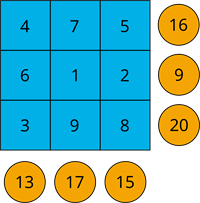
- We have a \(3 \times 3 \ \) grid.
- We fill it with numbers \(1\) to \(9 \ \) without repeating.
- Yellow circles outside the grid show the sum of each row or column.
Example: If the first row is \(4\), \(7\), \(5\), its sum is \(4 + 7 + 5 = 16\). So, '\(16\)' is written outside.
Filling the Grid
If we know the sums for rows and columns, we can fill missing numbers by: - Making sure there are no repeating numbers.
- Making sure each row and column matches the sum given outside.
Why Row Sums and Column Sums Add to \(45\)?
- Numbers \(1\) to \(9\) add up to \(45\)
- Since all \(9\) numbers appear exactly once in the grid:
- Adding all row sums together \(= 45\)
- Adding all column sums together \(= 45\)
- This is always true for any \(3 \times 3\) grid using \(1 - 9\).
Magic square - \(3 \times 3\)
A magic square is a grid with numbers arranged so the row, column, and diagonal sums are all the same. In a \(3×3\) magic square with numbers \(1 - 9\), the magic sum is always \(15\).
Arranging Numbers:
- \(1\) and \(9\) cannot be in a corner in a magic square. They must be in the middle of an edge.
- \(5\) is always in the centre of the grid.
- Opposite cells always add to \(10\) (e.g. \(2 \ \& \ 8\), \(3 \ \& \ 7\))
- Each row, column, and diagonal totals \(15\).
General form of \(3 \times 3\) magic square:
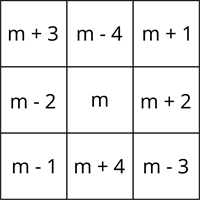
Let the centre of the grid be \(m\).
A \(3 \times 3\) magic square built from consecutive numbers has this pattern relative to the centre.
Let the centre of the grid be \(m\).
A \(3 \times 3\) magic square built from consecutive numbers has this pattern relative to the centre.
Virahāṅka–Fibonacci Sequence
The sequence \(1\), \(2\), \(3\), \(5\), \(8\), \(13\), \(21\), \(34\), \(55\), .... is called the Virahāṅka–Fibonacci sequence. It is one of the most famous number patterns in mathematics and appears in art, music, architecture, science, and nature.
Writing a Number as the Sum of 1's and 2's
The same idea can be understood mathematically by writing a number as the sum of \(1\)'s and \(2\)'s in all possible ways.
Different ways of writing numbers
| Different Ways | Number of Ways | |
| \(n = 1\) | \(1\) | \(1\) |
| \(n = 2\) |
\(1 + 1\)
\(2\)
|
\(2\) |
| \(n = 3\) |
\(1 + 1 + 1\)
\(1 + 2\)
\(2 + 1\)
|
\(3\) |
| \(n = 4\) |
\(1 + 1 + 1 + 1\)
\(1 + 1 + 2\)
\(1 + 2 + 1\)
\(2 + 1 + 1\)
\(2 + 2\)
|
\(5\) |
Notice the pattern in the Number of Ways column:
This gives the sequence \(1\), \(2\), \(3\), \(5\), \(8\), ...
This sequence is called a Virahanka Sequence.
Rule for Virahanka Numbers: Each number is obtained by adding the two previous numbers.
Digits in Disguise
Cryptarithms are mathematical puzzles, where numbers are replaced by letters or symbols. Each letter represents a unique digit, and the challenge is to decode the puzzle using logical reasoning and arithmetic skills. Cryptarithms is also called as alphametics.
Each letter stands for one number from \(0\) to \(9\). The goal is to find which digit each letter represents.
How to Solve Digits in Disguise?
- Remember each letter is one number, always the same number wherever it appears.
- Different letters stand for different numbers.
- Use simple math rules to guess which numbers fit.
- Check if the sum or product is right after you guess.