

Numbers can describe not only quantities but also movements. A movement has two important features: how far something moves and in which direction it moves.
We can use positive and negative integers to record these two pieces of information. Let us see how this works using a carrom coin moving on a number line.
We can use positive and negative integers to record these two pieces of information. Let us see how this works using a carrom coin moving on a number line.
Understanding Integers through Movement
Imagine a carrom coin placed at \(0\) on a number line. The coin can be struck to move either to the right or to the left.
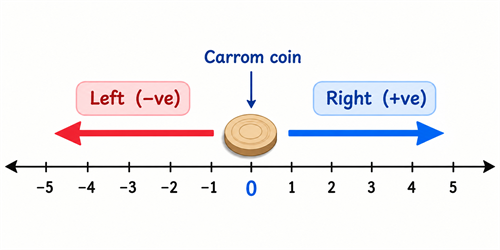
We choose:
- Movement to the right \(\rightarrow\) positive
- Movement to the left \(\rightarrow\) negative
If the coin moves \(4\) units to the right, we write its movement as \(+4\).
If the coint moves \(4\) units to the left, we write it as \(-4\).
Thus, the sign tells the direction, while the number tells how far the coin moves.
Two Strikes
Suppose the coin starts at \(0\). It struck twice. The first strike moves it \(4\) units to the right and the second strike moves it \(3\) units to the right.
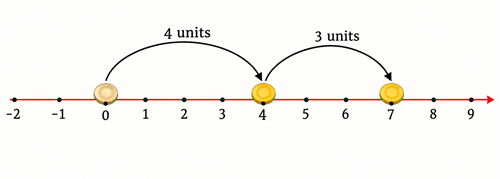
The movements are \(+4\) and \(+ 3\).
So, the final position is \(4 + 3 = 7\).
In general, if the first movement is \(a\) and the second movement is \(b\), then the final position is \(P = a + b\).
The movements \(a\) and \(b\) can be positive or negative depending on their directions.
What if the Directions are Different?
Suppose the coin starts at \(0\). The first strike moves it \(5\) units to the right and the second strike moves it \(7\) units to the left.
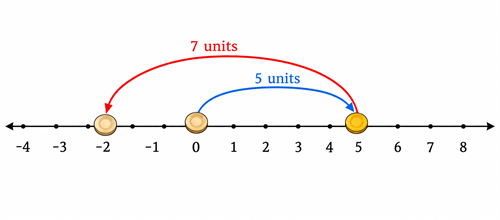
The first movement is \(+5\) and the second movement is \(-7\).
Therefore, \(P = 5 + (-7) = -2\).
So, the coin finally reaches \(-2\), which means it is \(2\) units to the left of \(0\).
Integers Using Tokens
We can also understand subtraction of integers using positive and negative tokens.
- Let
 Potitive tokens represent \(+1\).
- Let
 Negative tokens represent \(-1\).
One positive token and one negative token together have value zero:
\((+) + (-1) = 0\)
Such a pair is called a zero pair.
Subtraction Using Tokens
We have \(7\) positive tokens, representing \(+7\). We want to subtract \(18\) positive tokens.
So, we add \(11\) zero pairs.
Each zero pair contains one positive and one negative token.
Now, remove the \(18\) positive tokens, as required by the subtraction.
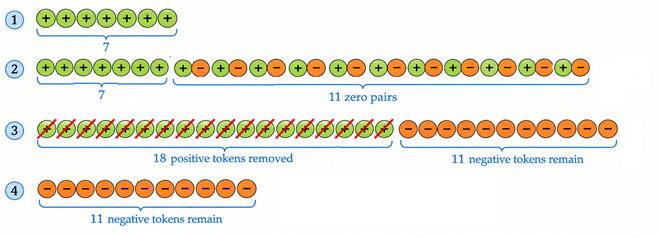
Only the \(11\) negative tokens remain.
Therefore, \(7 - 18 = -11\).
The token model helps us see an important property:
Subtracting an integer is the same as adding its additive inverse.
The additive inverse of \(+18\) is \(-18\).
Because \(18 + (-18) = 0\).
Therefore, \(7 - 18 = 7 + (-18) = -11\).
For any integers \(a\) and \(b\),
\(a - b = a + (-b)\)