

When several integers appear in one expression, we do not always have to calculate them from left to right. Sometimes we can group, rearrange or break apart the numbers to make the calculation easier.
Let us discover why this works.
Grouping Integers in Multiplication:
Which pair should we multiply first?
Way \(1\): \((5 \times (-3)) \times 4 = (-15) \times 4 = -60\)
Way \(2\): \(5 \times ((-3) \times 4) = 5 \times (-12) = -60\)
Both ways lead to the same product.
Thus, while multiplying integers, changing the grouping does not change the product.
For any integers \(a\), \(b\) and \(c\),
\((a \times b) \times c = a \times (b \times c)\)
This is the associative property of multiplication.
Example:
Consider \(5 \times (-3) \times 4\).
\((5 \times (-3)) \times 4 = -15 \times 4 = -60\)
\(5 \times ((-3) \times 4) = 5 \times (-12) = -60\)
When several integers are multiplied, look for numbers that are easy to multiply together first.
The Sign Detective:
Let us look at a simple pattern using negative tokens:
\((-1) \times (-1) = +1\)
\((-1) \times (-1) \times (-1) = -1\)
\((-1) \times (-1) \times (-1) \times (-1) = +1\)
\((-1) \times (-1) \times (-1) \times (-1) \times (-1) = -1\)
The sign keeps changing as another \(-\) is multiplied.
So, we observe:
When \(-1\) is multiplied even number \((\)like \(2\) or \(4)\) of times, the product is positive.
When \(-1\) is multiplied odd number \((\)like \(3\) or \(5)\) of times, the product is negative.
This gives us a quick way to decide the sign when many integers are multiplied.
Distributive Property Using Tokens:
Now, consider \(4 \times (2 + (-3))\).
Let us represent one group using tokens:

It contains \(2\) positive tokens and \(3\) negative tokens.
We need \(4\) such groups:
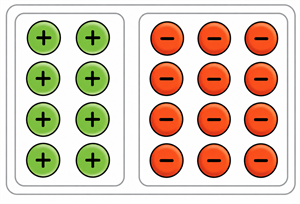
There are \(4\) groups of \(2\) positive tokens:
\(4 \times 2 = 8\)
There are \(4\) groups of \(3\) negative tokens
\(4 \times (-3) = -12\)
Therefore, \(4 \times (2 + (-3)) = (4 \times 2) + (4 \times (-3))\)
\(= 8 + (-12)\)
\(= -4\)
The token arrangement shows that multiplying the whole group gives the same result as multiplying each part separately and then adding.
Therefore,
For any integers \(a\), \(b\) and \(c\),
\(a \times (b + c) = (a \times b) + (a \times c)\)
This is the distributive property of multiplication over addition.
Picking Pattern:
Imaging a machine that accepts three integers and follows a secret rule.
Suppose its rule is \(a + b - c\), where \(a\), \(b\) and \(c\) are the first, second and third inputs.
Put \(5\), \(8\) and \(3\).
The machine gives \(5 + 8 - 3 = 10\).
What if negative integers enter the machine?
For \(-4\), \(-1\) and \(-6\).
The same rule gives, \((-4) + (-1) + (-6) = 5 - 6 = -1\).
The rule has not changed - only the input numbers have changed.
When the rule of a number machine is unknown, study several input-output pairs, look for a pattern and try to uncover the hidden operations.