

Magic Grid of Integers
We have seen how integers can be added, subtracted and multiplied. Let us now explore an interesting grid in which the numbers are arranged in a special way.
How to play the game?
- Circle any number in the grid.
- Cross out every number in the same row and column as the chosed number.
- From the remaining numbers that are not striked, circle another number.
- Again, strike out its row and column.
- Continue untill there are no more unstruck numbers.
- Multiply all the circled numbers.
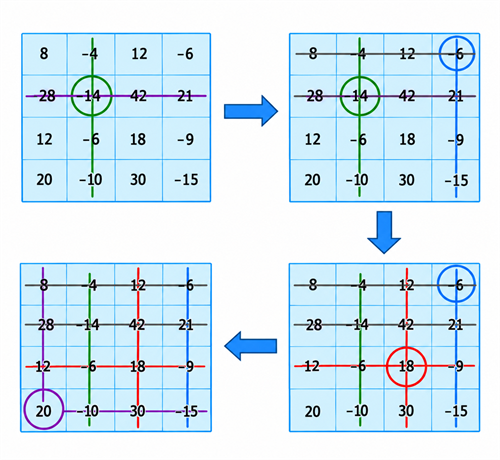
We can try the game several times by choosing different numbers. Observe the product each time.
Important!
What do you notice?
Although different numbers may be circled, the product remains the same for the given grid.
This happens because the numbers in the grid are not placed randomly. Their arrangement is designed so that the different possible selections produce the same product.
Division of Integers
We have already seen that multiplication and division are closely related. And, we can understand division of integers is the reverse of multiplication.
For example, \((-100) \div 25\).
We can ask the question as "what number multiplied by \(25\) gives \(-100\)?"
Since \(25 \times (-4) = -100\), we get \(-100 \div 25 = -4\).
Now, consider \((-100) \div (-4)\).
We can ask the question as "what number multiplied by \(-4\) gives \(-100\)?"
Since \((-4) \times 25 = -100\), we get \(-100 \div (-4) = 25\).
So, we can use the multiplication facts we already know to understand the integer division.
What happens to the signs?
First divide the magnitudes as usual. Then determine the sign from the signs of the integers.
| Signs of the numbers | Sign of result |
| \((+) \div (+)\) | \(+\) |
| \((+) \div (-)\) | \(-\) |
| \((-) \div (+)\) | \(-\) |
| \((-) \div (-)\) | \(+\) |
For positive integers \(a\), \(b\) with \(b \ne 0\),
\(a \div (-b) = - (a \div b)\)
\((-a) \div b = - (a \div b)\)
\((-a) \div (-b) = a \div b\)