

Multiplication of Integers
We have already used tokens to understand addition and subtraction of integers. Let us now use the same token model to understand multiplication of integers.
Multiplication Using Tokens
Suppose we start with an empty bag and put \(2\) positive tokens into it \(4\) times.
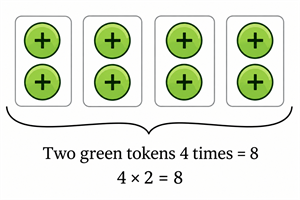
So, \(4 \times 2 = 8\).
Here, \(4\) tells us how many times the group is taken, and \(2\) tells us how many tokens are in each group.
In multiplication, \(a \times b = c\)
- \(a\) is the multiplier - the first number
- \(b\) is the multiplicand - the second number
- \(c\) is the product - the result of the multiplication
For example, in \(4 \times 2 = 8\),
\(4\) is the multiplier, \(2\) is the multiplicand and \(8\) is the product.
Multiplying a Positive Integer by a Negative Integer:
Let a green token represent \(+1\) and a red token represent \(-1\).
Consider \(4 \times (-2)\).
For this, we put \(2\) negative tokens into an empty bag \(4\) times.
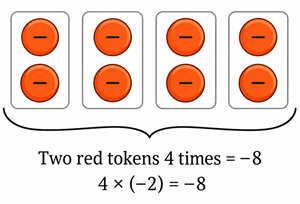
Thus, there are \(8\) negative tokens in the bag, representing \(-8\).
Hence, \(4 \times (-2) = -8\).
So, when the multiplier is positive, we place the required tokens into the bag.
What if the Multiplier is Negative?
Consider \((-4) \times (-2)\).
Here, the multiplier is negative. We interpret this as removing \(2\) positive tokens from the bag \(4\) times.
But the bag is empty. So, as we did while subtracting the integers, we first put zero pairs into the bag.
Each zero pair contains one positive and one negative token.
\((+1) + (-1) = 0\)
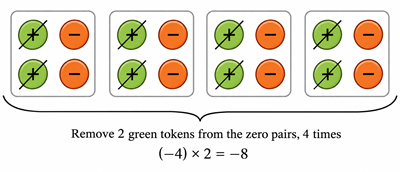
We put \(2\) zero pairs into the bag and remove the \(2\) positive tokens. Repeat this process \(4\) times. After removing the positive tokens, \(8\) negative tokens remain.
Therefore, \((-4) \times 2 = -8\).
What if Both Integers are Negative?
Consider \((-4) \times (-2)\).
Since the multiplier is negative, we need to remove \(2\) negative tokens \(4\) times.
But the bag is empty. So, we first add zero pairs. Each time, we remove the \(2\) negative tokens.
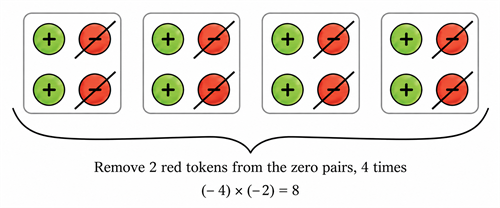
After doing this \(4\) times, \(8\) positive tokens remain.
Therefore, \((-4) \times (-2) = 8\).
Thus, using tokens, we obtain:
\(4 \times 2 = 8\)
\(4 \times (-2) = -8\)
\(4 \times (-2) = -8\)
\((-4) \times (-2) = 8\)
Multiplication by \(1\) and \(-1\)
Consider \(1 \times a\).
If \(a\) is positive, the value is \(a\) only.
This is also true when \(a\) is negative. Using the token model, we put \(a\) negative tokens into the bag once, so the bag contains \(a\).
For example, \(1 \times (-5) = -5\).
Hence,
\(1 \times a = a\), for every integer \(a\).
Now, consider \((-1) \times a\).
The product has the same magnitude as \(a\), but its sign is opposite to that of \(a\).
Therefore, it is the additive inverse of \(a\).
For example,
\((-1) \times 5 = -5\) and \((-1) \times (-5) = 5\)
Hence,
\((-1) \times a = -a\), for every integer \(a\).
Multiplication is Commutative
Consider \(3 \times (-2) = -6\) and \((-2) \times 3 = -6\)
The product is the same when the multiplier and multiplicand are swapped.
Multiplication of integers is commutative.
\(a \times b = b \times a\), for any two integer \(a\) and \(b\).
Brahmagupta's Rules
Brahmagupta, in his Brāhmasphuṭasiddhānta \((628 \ CE)\), gave rules for multiplying and dividing positive and negative numbers.
| Numbers | Product / Quotient |
|
Positive \(\times\) Positive
Positive \(\div\) Positive
|
Positive |
|
Negative \(\times\) Negative
Negative \(\div\) Negative
|
Positive |
|
Positive \(\times\) Negative
Positive \(\div\) Negative
|
Negative |
|
Negative \(\times\) Positive
Negative \(\div\) Positive
|
Negative |
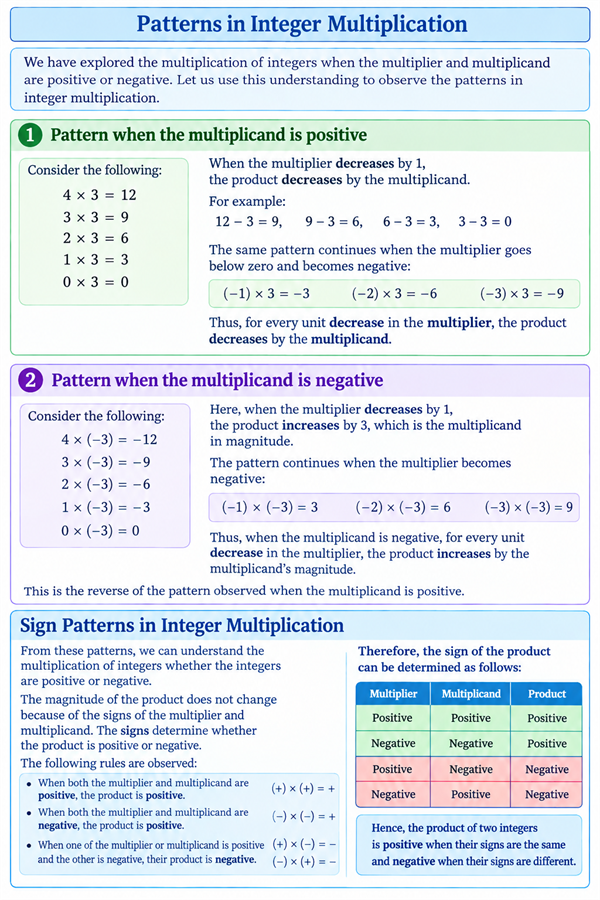
For both multiplication and division:
Same signs \(\rightarrow\) Positive
Different signs \(\rightarrow\) Negative
Important!
The magnitude of the product or quotient is determined by the magnitudes of the numbers; their signs determine whether the result is positive or negative.