

Intersecting Lines:
Two lines are said to be intersecting lines if they meet or cross each other at a common point.
This common point is called the point of intersection.
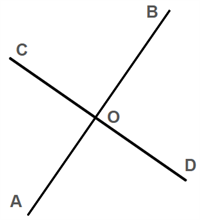
When two lines intersect, they form four angles at the point of intersection. These angles show interesting relationships:
Let us discuss what linear pair of angles are.
Definition:
Linear pair of angles should add up to \(180°\).
In other words, the sum of the linear pair of angles is supplementary (\(180^{\circ}\)).
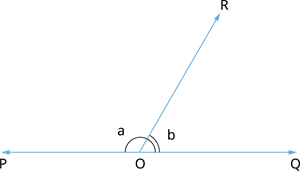
In the figure, the sum of the linear angles \(POR\) and \(ROQ\) is equal to \(180^{\circ}\).
That is, \(a + b = 180^{\circ}\).
Example:
If \(x\) and \(y\) are the measures of linear pair of angles, then find the value of \(y\) given \(x\) \(=\) \(65^{\circ}\).
Solution:
Given that, \(x\) \(=\) \(65^{\circ}\).
By the property of linear pair of angles, \(x\) \(+\) \(y\) \(=\) \(180^{\circ}\).
\(\Rightarrow 65^{\circ} + y = 180^{\circ}\)
\(\Rightarrow y = 180^{\circ} - 65^{\circ}\)
\(\Rightarrow y = 115^{\circ}\)
Some real life examples:
The following are some real-life examples where we can observe linear pair of angles.
- The ladder makes a linear pair of angles with the ground.
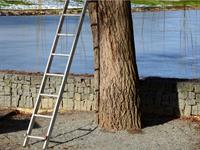
- The writing quill in the inked dip makes a linear pair of angle with the table.

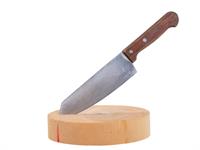
- The knife makes a linear pair of angle with the chopping board.
vertically opposite angles:
When two lines intersect at a particular point, the vertically opposite angles formed are equal in measure.
Illustration:
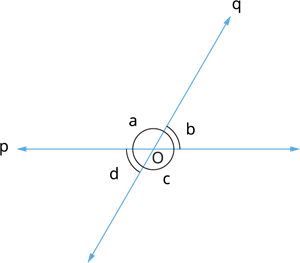
In the figure, the lines \(p\) and \(q\) intersect at \(O\) forming four pair of angles \(a\), \(b\), \(c\) and \(d\).
The angle \(a\) is vertically opposite to \(c\), and the angle \(b\) is vertically opposite to \(d\) and vice versa.
Here \(\angle a\) \(=\) \(\angle c\) and \(\angle b\) \(=\) \(\angle d\).
Let us prove the above equivalence as follows:
Consider \(\angle a\) and \(\angle b\).
These two angles form a linear pair. Hence by the property of linear pair of angles \(\angle a + \angle b = 180^{\circ}\).
\(\Rightarrow\) \(\angle a\) \(=\) \(180^{\circ}\) \(-\) \(\angle b\) ……\((1)\)
Also, \(\angle b\) \(=\) \(180^{\circ}\) \(-\) \(\angle a\) ……\((2)\)
Consider \(\angle b\) and \(\angle c\).
These two angles form a linear pair. Hence by the property of linear pair of angles \(\angle b + \angle c = 180^{\circ}\).
\(\Rightarrow\) \(\angle c\) \(=\) \(180^{\circ}\) \(-\) \(\angle b\) ……\((3)\)
Thus from equations \((1)\) and \((3)\) we have:
\(\angle a\) \(=\) \(\angle c\)
Similarly, consider \(\angle a\) and \(\angle d\).
These two angles form a linear pair. Hence by the property of linear pair of angles \(\angle a + \angle d = 180^{\circ}\).
\(\Rightarrow\) \(\angle d\) \(=\) \(180^{\circ}\) \(-\) \(\angle a\) ……\((4)\)
And from equations \((2)\) and \((4)\) we have:
\(\angle b\) \(=\) \(\angle d\)
Therefore, the vertically opposite angles formed by the lines \(p\) and \(q\) at the point \(O\) are equal in measure.
Example:
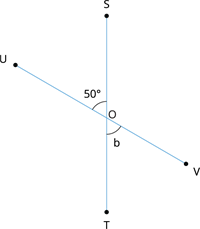
Find the unknown angle \(b\) in the figure.
Solution:
From the figure, we observe that the \(\angle SOU\) and \(\angle TOV\) are vertically opposite angles formed by the line segments \(ST\) and \(UV\).
By definition, the vertically opposite angles are equal.
Thus \(\angle SOU\) \(=\) \(\angle TOV\).
\(\Rightarrow\) \(b\) \(=\) \(50^{\circ}\)
Therefore, the unknown angle \(b\) is \(50^{\circ}\).