

Intersecting Lines and Vertically Opposite Angles
When two straight lines meet at a single point on a flat plane, they are called intersecting lines. The point where they meet is the point of intersection.
Vertically Opposite Angles
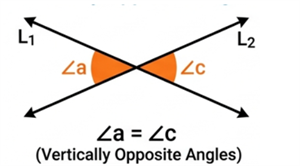
When two lines intersect, they form four angles. The pairs of angles that are opposite to each other across the vertex are called vertically opposite angles.
Key Property: Vertically opposite angles are always equal to each other.
If lines \(l\) and \(m\) intersect, then the angle on the left equals the angle on the right, and the angle on top equals the angle on the bottom.
Linear Pairs
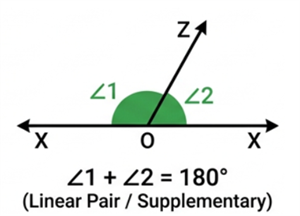
Angles that lie next to each other on a straight line and share a common arm are called a linear pair.
Key Property: The angles in a linear pair add up to 180° (they are supplementary).
Perpendicular Lines
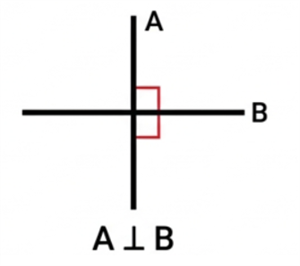
When two lines intersect each other in such a way that the angles formed between them are all \(90^\circ\) (right angles), the lines are said to be perpendicular lines.
If all four angles at the intersection point are equal, each must be exactly \(90^\circ\) because the full rotation around a point is \(360^\circ\) (\(\frac{360^\circ}{4} = 90^\circ\)).
Symbolically, if line \(l\) is perpendicular to line \(m\), it is written as \(l \perp m\).
Parallel Lines
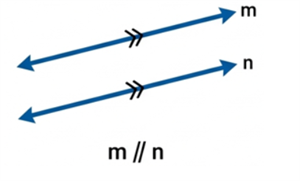
When two or more lines lie on the same plane surface but never intersect each other, no matter how far they are extended in either direction, they are called parallel lines.
Key Property: The perpendicular distance between two parallel lines remains constant throughout their entire length.Symbolically, if line \(l\) is parallel to line \(m\), it is written as \(l \parallel m\).
Transversal Lines and Angle Relationships
A line that intersects a pair of two or more lines at distinct points is called a transversal line (often denoted as \(t\)).
When a transversal intersects two lines, it forms two sets of four angles (\(8\) angles in total).
Corresponding Angles:
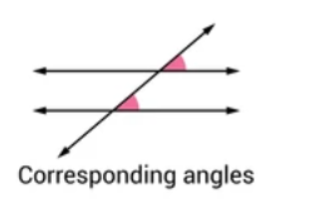
Angles that are in the same relative position at each intersection (e.g., top-right of both intersections) are called corresponding angles.
Property: When a transversal intersects a pair of parallel lines, the corresponding angles are equal.
Alternate Interior Angles:
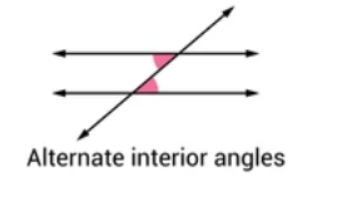
The interior angles that lie on opposite sides of the transversal line (forming a 'Z' shape) are called alternate interior angles.
Property: When a transversal intersects a pair of parallel lines, the alternate interior angles are equal.
Co-interior Angles (Interior Angles on the Same Side):
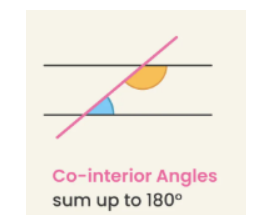
The interior angles that lie on the exact same side of the transversal line are called co-interior angles.
Property: When a transversal intersects a pair of parallel lines, the co-interior angles are supplementary, meaning they add up to 180°.5.
Checking for Parallel Lines (Testing Parallelism):
The angle relationships can be used in reverse to check whether two given lines are parallel or not.
Two lines cut by a transversal are guaranteed to be parallel if any one of the following conditions is met:
-
Any pair of corresponding angles are found to be equal.
-
Any pair of alternate interior angles are found to be equal.
-
Any pair of co-interior angles add up to exactly \(180^\circ\).