

In our everyday life, we often need to measure things very accurately. Sometimes, a small difference in length or size can make a big difference in how things fit or work.
For example:
-
A toy might not work if the screw is just a little too short or too long.
-
A machine part might not fit if the measurement is slightly off.
-
A fish or an insect might be only a tiny bit longer than another, but that matters in science.
Now, learn about the place values of the decimal part.
The first digit which placed after a decimal point is called tenths place. The tenth place is \(\frac{1}{10}\) of the number.
The second digit which placed after a decimal point is called the hundredth place. The hundredth place is .

We can also show decimals using blocks.
1. Hundreds block have \(100\) boxes.
2. Tens block have \(10\) boxes.
3. Ones block have \(1\) box.
4. Tenths block have boxes of ones block.
5. Hundredths block have boxes of ones block.
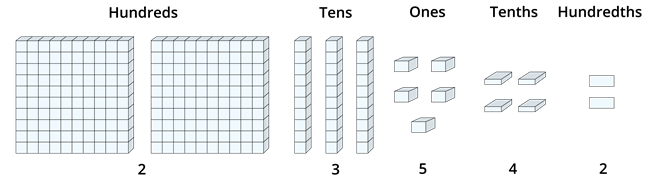
In the above image:
\(2\) hundreds box + \(3\) tens box + \(5\) ones box + \(4\) tenths box + \(2\) hundredths box
This number can be read as "two hundred thirty-five and forty-two hundredth".
It also can be read as "two hundred thirty-five point four two".
This also can be represented in the place value table.

The third digit which placed after a decimal point is called the thousandth place. The thousandth place is .
Important!
\(\frac{1}{10}\) means \(1\) part out of \(10\) parts of a whole.
means \(1\) part out of \(100\) parts of a whole.
means \(1\) part out of \(1000\) parts of a whole.
General rule for representing decimals on a number line:
Step 1: Let us first find on which two integers where the decimal number lie.
Step 2: Divide the length between those two integers into ten equal parts.
Step 3: Move as many steps you want from the preceding integer to the right.
Step 4: You will reach the decimal number on the number line.
Locate \(0.5\) on the number line.
Step 1: The decimal number \(0.5\) lies between \(0\) to \(1\).
Step 2: Divide the length between \(0\) to \(1\) into ten equal parts.
Step 3: Move five-step to the right from \(0\).
Step 4: The number reached on the number line is \(0.5\).

General rule for comparing decimals:
Step 1: First compare the highest place values of whole parts of two decimal numbers.
Step 2: If the highest place values of two decimals are the same, then compare the second-highest place of digits.
Step 3: If the whole part is the same, then compare the decimal part of tenth place.
Step 4: If it is also same, then compare the decimal part of the hundredth place. The same procedure can be extended to any number of decimal digits.
Step 2: If the highest place values of two decimals are the same, then compare the second-highest place of digits.
Step 3: If the whole part is the same, then compare the decimal part of tenth place.
Step 4: If it is also same, then compare the decimal part of the hundredth place. The same procedure can be extended to any number of decimal digits.
Example:
1. Compare \(67.62\) and \(33.41\).
Here, the highest place value is tens place, which is different in both the numbers.
\(6\) \(>\) \(3\)
Therefore, \(67.62\) \(>\) \(33.41\).
Adding zeros at the right end of decimal digits do not change the value of that decimal number.
1. \(25.1 = 25.10\)
2. \(621.035 = 621.0350\)