

Introduction to decimal numbers:
In our everyday life, we often need to measure things very accurately. Sometimes, a small difference in length or size can make a big difference in how things fit or work.
For example:
-
A toy might not work if the screw is just a little too short or too long.
-
A machine part might not fit if the measurement is slightly off.
-
A fish or an insect might be only a tiny bit longer than another, but that matters in science.
Now, learn about the place values of the decimal part.
The first digit which placed after a decimal point is called tenths place. The tenth place is \(\frac{1}{10}\) of the number.
The second digit which placed after a decimal point is called the hundredth place. The hundredth place is .

We can also show decimals using blocks.
1. Hundreds block have \(100\) boxes.
2. Tens block have \(10\) boxes.
3. Ones block have \(1\) box.
4. Tenths block have boxes of ones block.
5. Hundredths block have boxes of ones block.
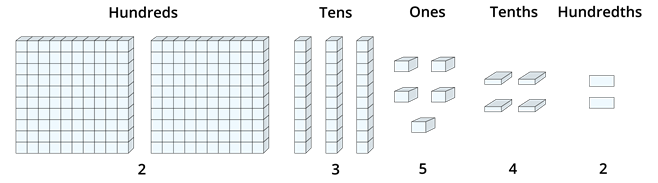
In the above image:
\(2\) hundreds box + \(3\) tens box + \(5\) ones box + \(4\) tenths box + \(2\) hundredths box
This number can be read as "two hundred thirty-five and forty-two hundredth".
It also can be read as "two hundred thirty-five point four two".
This also can be represented in the place value table.

The third digit which placed after a decimal point is called the thousandth place. The thousandth place is .
Important!
\(\frac{1}{10}\) means \(1\) part out of \(10\) parts of a whole.
means \(1\) part out of \(100\) parts of a whole.
means \(1\) part out of \(1000\) parts of a whole.
Unit of Measurements:
In our daily lives, we use different units to measure length, such as millimeters (mm), centimeters (cm), and meters (m). These units are part of the metric system, which is widely used around the world for its simplicity and consistency
Millimeters and Centimeters:
We already know from earlier classes that
\(1 \, \text{cm} = 10 \, \text{mm}\)
This means that each millimeter is one-tenth of a centimeter
\(1 \, \text{mm} = \frac{1}{10} \, \text{cm} = 0.1 \, \text{cm}\)
So, we can easily convert between \(millimeters\) and \(centimeters\) by dividing or multiplying by \(10\)
To convert Millimeter to Centimeter:
- To convert \(mm\) to \(cm\), divide by \(10\)
- To convert \(cm\) to \(mm\), multiply by \(10\)
Example:
\(5 \, \text{mm} = \frac{5}{10} \, \text{cm} = 0.5 \, \text{cm}\)
\(5.6 \, \text{cm} = 5.6 \times 10 = 56 \, \text{mm}\)
We also use \(\text{meters (m)}\) for measuring longer lengths.
We know that
\(1 \, \text{m} = 100 \, \text{cm}\)
This means that each centimeter is
\(1 \, \text{cm} = \frac{1}{100} \, \text{m} = 0.01 \, \text{m}\).
So, we convert between centimeters and meters by dividing or multiplying by \(100\).
To convert between centimeters and meters:
- To convert \(\text{cm to m}\), divide by \(100\).
- To convert \(\text{m to cm}\), multiply by \(100\).
Example:
\(15 \, \text{cm} = \frac{15}{100} \, \text{m} = 0.15 \, \text{m}\).
In our daily life, we often measure the weight of different objects and substances such as groceries, fruits, vegetables, and even medicines.
\(1 \, \text{kilogram (kg)} = 1000 \, \text{grams (g)} \)
This means that each gram is one-thousandth of a kilogram
\(1 \, \text{g} = \frac{1}{1000} \, \text{kg} = 0.001 \, \text{kg} \)
Grams and Kilograms:
We already know that\(1 \, \text{kilogram (kg)} = 1000 \, \text{grams (g)} \)
This means that each gram is one-thousandth of a kilogram
\(1 \, \text{g} = \frac{1}{1000} \, \text{kg} = 0.001 \, \text{kg} \)
To convert between grams and kilograms:
- To convert grams to kilograms, divide by \(1000\)
- To convert kilograms to grams, multiply by \(1000\)
Example:
\(5 \, \text{g} = \frac{5}{1000} \, \text{kg} = 0.005 \, \text{kg} \).
Milligrams and Grams:
For smaller weights, especially in medicines, we use milligrams (mg). We know that
\(1 \, \text{gram (g)} = 1000 \, \text{milligrams (mg)}\)
\(\Rightarrow 1 \, \text{mg} = \frac{1}{1000} \, \text{g} = 0.001 \, \text{g} \)
So again, we can convert between milligrams and grams by dividing or multiplying by \(1000\).
To convert between milligram and grams:
- To convert milligram to grams, divide by \(1000\)
- To convert grams to milligrams, multiply by \(1000\)
Important!
The metric units commonly used to measure weight are: Milligrams (mg),Grams (g),Kilograms (kg).
Rupee and Paise:
In India, the rupee is the basic unit of money. A rupee is divided into \(100\) smaller units called paise.
We often see prices written in paise in bills, receipts, and bank statements.
\(1 \, \text{rupee} = 100 \, \text{paise}\)
\(1 \, \text{paisa} = \frac{1}{100} \, \text{rupee} = 0.01 \, \text{rupee}\)
To convert between paise and rupee:
- From paise to rupee: divide by \(100\)
- From rupee to paise: multiply by \(100\)
Example:
\(5 \, \text{paise} = \frac{5}{100} \, \text{rupee} = 0.05 \, \text{rupee}\).
\(0.50 \, \text{rupee} = 0.50 \times 100 = 50 \, \text{paise}\).