

Number Play is like a secret code game with numbers!
Follow a simple rule, and the numbers reveal a hidden trick.
Let us see a sample of this.
A group of children decided to play a new game. They lined up in a row, tallest to shortest, all mixed up, and each child had to shout out a special secret number.
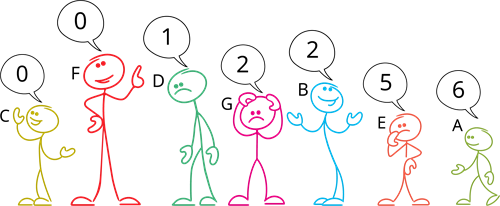
What secret are these numbers trying to share?
Every child looked only at the children standing in front of them in the line.
They counted how many of those children were taller than they were.
That count became their secret number.
They counted how many of those children were taller than they were.
That count became their secret number.
Now, the children then rearranged themselves in a different order and played again.
"Will their secret number change if they stand in a different place?"
Let us check.
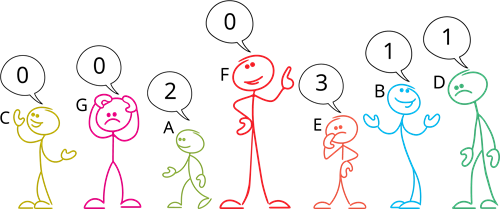
Yes, the secret number has changed.
This is because it is not about how tall they are, but how tall they are compared to the people in front of them.
What is Parity?
Parity tells us if a number is even or odd:
- An even number leaves no remainder when divided by \(2\). It is called even parity (eg, \(6 \div 2 = 3\) with remainder \(0\)).
- An odd number leaves a remainder of \(1\) when divided by \(2\). It is called odd parity (eg, \(7 \div 2 = 3\) with remainder \(1\)).
Addition Parity:
odd \(+\) odd \(=\) even
even \(+\) even \(=\) even
odd \(+\) even \(=\) odd
Subtraction Parity:
odd \(-\) odd \(=\) even
even \(-\) even \(=\) even
odd \(-\) even \(=\) odd
Product of Parity:
odd \(\times\) even \(=\) even
odd \(\times\) odd \(=\) odd
even \(\times\) even \(=\) even