

The Grid and the Rule
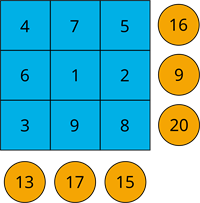
- We have a \(3 \times 3 \ \) grid.
- We fill it with numbers \(1\) to \(9 \ \) without repeating.
- Yellow circles outside the grid show the sum of each row or column.
Example: If the first row is \(4\), \(7\), \(5\), its sum is \(4 + 7 + 5 = 16\). So, '\(16\)' is written outside.
Filling the Grid
If we know the sums for rows and columns, we can fill missing numbers by:
- Making sure no repeating number.
- Making sure each row and column matches the sum given outside.
Why Row Sums and Column Sums Add to \(45\)?
- Numbers \(1\) to \(9\) add up to \(45\)
\(1 + 2 + 3 + ... + 8 + 9 = 45\)
- Since all \(9\) numbers appear exactly once in the grid:
- Adding all rows sums together \(= 45\)
- Adding all column sums together \(= 45\)
- This is always true for any \(3 \times 3\) grid using \(1 - 9\).