

Taxicab Numbers:
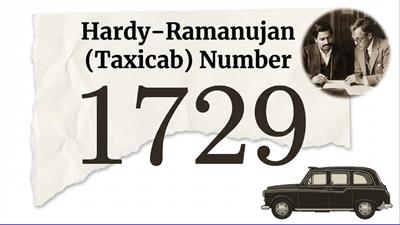
The Hardy - Ramanujan Number: \(1729\)
Mathematician G.H. Hardy visited Ramanujan in the hospital, arriving by taxicab number \(1729\). Hardy called it as "dull," but Ramanujan instantly replied it was the smallest number expressible as a sum of two cubes in two different ways:
\(1729 = 1^3 + 12^3 = 9^3 + 10^3\).
Therefore, those numbers are now called Taxicab Numbers.
Perfect Cubes and Consecutive Odd Numbers:
1. Every perfect cube \(n^3\) can be expressed as the sum of exactly \(n\) consecutive odd numbers, where the first odd number is \(n(n-1)+1\)
\(1 = 1 = 1^3\)
\(3 + 5 = 8 = 2^3\)
\(7 + 9 + 11 = 27 = 3^3\)
\(13 + 15 + 17 + 19 = 64 = 4^3\)
\(21 + 23 + 25 + 27 + 29 = 125 = 5^3\)
\(31 + 33 + 35 + 37 + 39 + 41 = 216 = 6^3\)
Example:
If \(n=3\)
The sequence starts at \(3(3 -1) + 1 = 7\)
And consists of \(3\) consecutive odd numbers starting from \(7\)
Thus, \(3^3 = 7 + 9 + 11 = 27\)
Important!
To express the cube of any number \(n\) you must add exactly \(n\) consecutive odd numbers together.
The sequence of odd numbers does not reset; it continues exactly where the previous cube's sequences left off.
2. The difference between the cubes of two consecutive natural numbers, \(n\) and \(n+1\) is given by
\((n+1)^3 - n^3 = 1 + (n + 1) \times 3n\)
Example:
Find the difference between \(64^3\) and \(65^3\)
Here, \(n = 64\)
\((64 + 1)^3 - 64^3 = 1 + (64 + 1)\times 3(64)\)
\(65^3 - 64^3 = 1 + 65 \times 64 \times 3\)
\(= 1+ 12480\)
\(65^3 - 64^3 = 12481\)
Reference:
National Council of Educational Research and Training (2025). Math - Standard 8. Ganita Prakash, Part I. A square and a cube - 1.2 Taxi Cab Numbers (pg. 13). Published at the Publication Division by the Secretary, National Council of Educational Research and Training, Sri Aurobindo Marg, New Delhi.