

Perfect squares and Odd Numbers
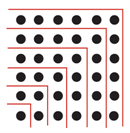
1. A useful pattern is that the difference between consecutive squares is an odd number. Alternatively, adding consecutive odd numbers starting from \(1\) gives consecutive square numbers. If \(n\) and \(n+1\) are consecutive squares, then \((n+1)^2 - n^2 = 2n+1\), which is odd.
Example:
- \(2^2 -1^1 = 4−1=3\), odd number
- \(3^2-2^2 = 9−4=5\), odd number
- \(4^2-3^2=16−9=7\), odd number
- \(5^2-4^2= 25−16=9\) odd number.
Visual representation of Pattern \(1\).
|
 |
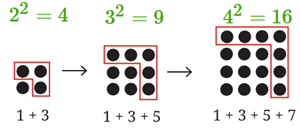
2. The sum of first the \(n\) odd numbers is \(n^2\). Alternatively, every square is a sum of successive odd numbers starting from \(1\).
Example:
-
\(1^2 = 1 = 1\)
-
\(2^2 = 4 = 1 + 3\)
-
\(3^2 = 9 = 1 + 3 + 5\)
-
\(4^2 = 16 = 1 + 3 + 5 + 7\)
Visual representation of Pattern \(2\):
3. Between the consecutive squares \(n^2\) and \((n+1)^2\), there are \(2n\) non- square numbers.
For example: Let us find the non-square numbers between \(2^2\) and \(3^2\). That is, between \(4\) and \(9\), there are \(2(2) = 4\) non-square numbers \(5, 6, 7\) and \(8\) .
Perfect Square and Triangular Number:
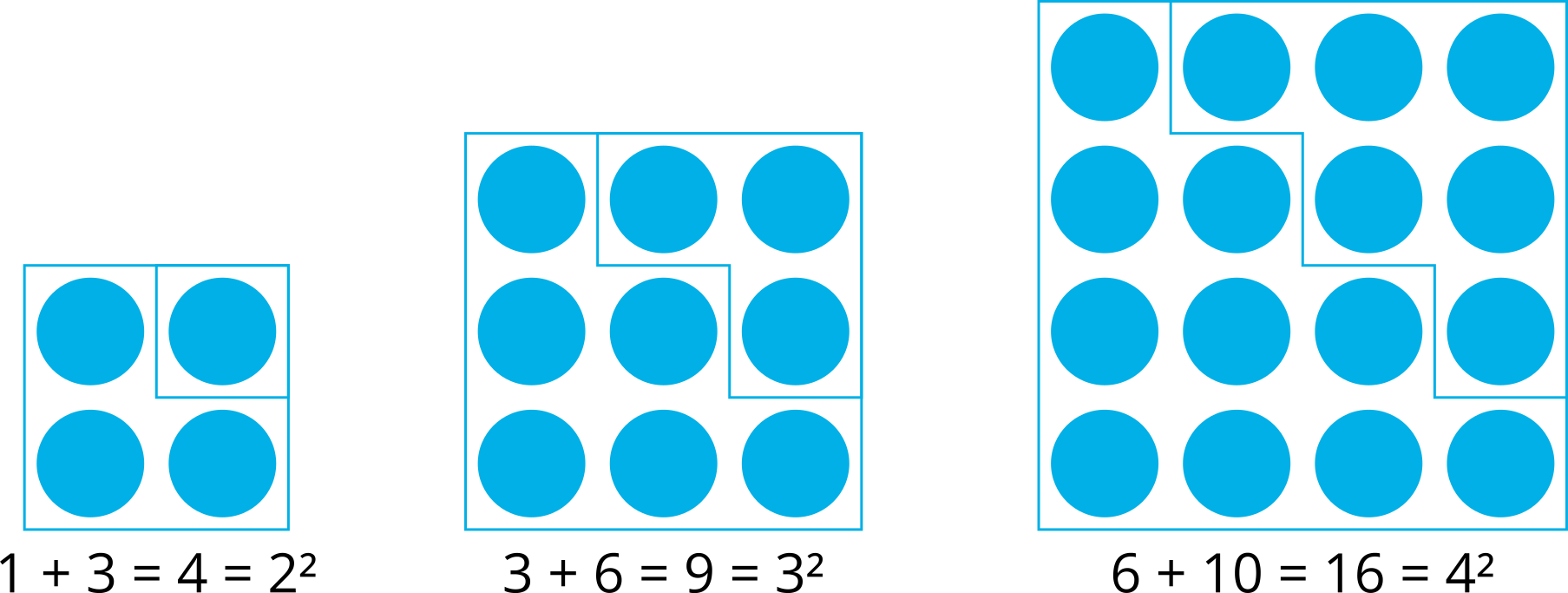
The sum of any two consecutive triangular numbers is always a perfect square.
The triangular numbers are \(1, 3, 6, 10,...\).
- \(1+3 = 4 =2^2\)
- \(3+6 = 9 = 3^2\)
- \(6+10 = 16 = 4^2\)
- \(10+15 = 25 = 5^2\)
Visual representation of perfect square and trianglular number:
Reference:
National Council of Educational Research and Training (2025). Maths - Standard 8. Ganita Prakash, Part I. A square and a cube - 1.1 Perfect Squares and Odd Numbers (pg. 5-7). Published at the Publication Division by the Secretary, National Council of Educational Research and Training, Sri Aurobindo Marg, New Delhi.