

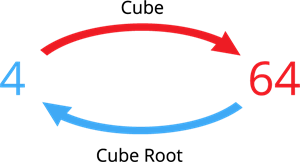
The inverse operation of a cube is a cube root. The symbol used to represent the cube root is \(\sqrt[3]{}\).
A cube root is a unique value that gives us the original number when we multiply it by itself three times.
The cube root of \(n\) is denoted by \(\sqrt[3]{n}\) or \(n^{\frac{1}{3}}\).
Example:
Find the cube root of \(64\).
Solution:
\(\sqrt[3]{64} = \sqrt[3]{4 \times 4 \times 4}\) \(= \sqrt[3]{4^3}\) \( = 4\)
Therefore, the cube root of \(64\) is \(4\).
From the observation of the above example, we can conclude that:
The cube of \(4\) is \(64\).
The cube root of \(64\) is \(4\).
Prime Factorisation method and perfect cube.
Steps to find the cube root of a number through prime factorisation:
Step 1: Find the prime factorisation of the given number.
Step 2: Group the factors in pairs of three numbers (triplets).
Step 3: If there are no factors left over, then the given number is a perfect cube. Otherwise, it is not a perfect cube.
Step 4: Now, take one factor common to each pair and multiply them.
Step 5: The obtained product is a cube root of a given number.
Example:
1. Find the value of \(\sqrt[3]{216}\).
Solution:
Let us first find the prime factor of \(216\).
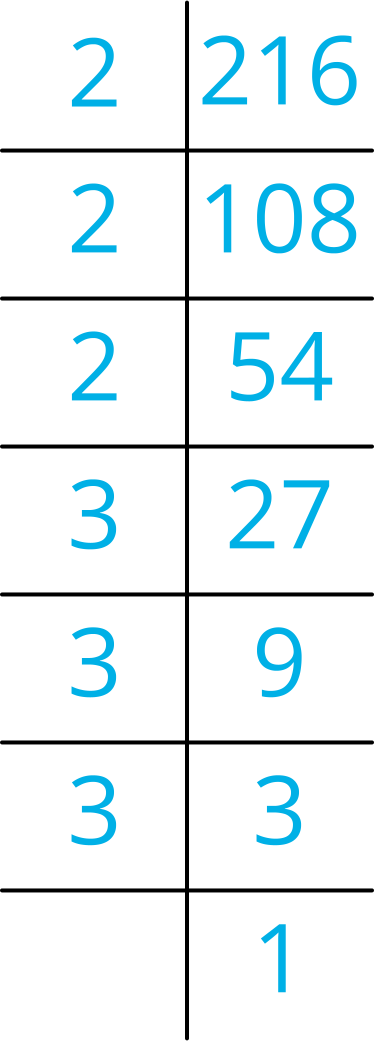
Group the factors in pairs of three numbers.
\(216 = (2 \times 2 \times 2) \times (3 \times 3 \times 3)\)
Here, no factor is leftover. Therefore, \(216\) is a perfect cube.
Now, take one factor common from each pair and multiply them.
\(\sqrt[3]{216} = 2 \times 3 = 6\)
Therefore, the value of \(\sqrt[3]{216} = 6\).
Properties of cube root:
1. Each prime factor of a number appears exactly \(3\) times in the prime factorisation of its cube. So, for a number to be a perfect cube, each prime in its factorisation must appear a multiple of \(3\) times.
Example:
Is \(3375\) a perfect cube?
Let us find the prime factors of \(3375\)
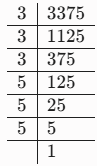
\(3375 = 3\times 3\times 3\times 5\times 5\times 5\)
\(3375 = (3\times 3\times 3)\times (5\times 5\times 5)\)
Therefore, the prime factors of \(3375\) form a triplet; there is no factor leftover.
So, \(3375\) is a perfect cube.
2. Taking successive differences of perfect cubes, all differences become equal after three levels.

Things to Know: History of squares and cubes:
Babylonian Tablets \((1700\ BCE)\): The first list of perfect squares and perfect cubes was compiled by the Babylonians as far back as \(1700\ BCE\). They first recorded perfect squares and cubes on clay tablets, used for land measurement and architectural design.
Varga: Ancient Sanskrit term meaning a square figure, its area or a number multiplied by itself.
Ghana: Sanskrit term for a solid cube or a number multiplied by itself three times.
Aryabhata's Definition \((499\ CE)\): Defined Varga as both a four-sided equal figure and the product of two equal quantities.
Why "Root"\((\sqrt{}\)? It comes from the Sanskrit word "Mula," meaning the "root of plant" or "origin."
Varga-mula: Means the origion of the square (square root).
Global journey: "Mula" was translated to Arabic (jidhr) and then to Latin (radix), giving us the modern radical symbol.
Brahmagupta's Rule \((628 CE)\): Stated that the pada (root/foot) of a square is the base number that creates it.
Reference:
National Council of Educational Research and Training (2025). Math - Standard 8. Ganita Prakash, Part I. A square and a cube - 1.2 Cube Root & A pinch of History (pg. 14-16). Published at the Publication Division by the Secretary, National Council of Educational Research and Training, Sri Aurobindo Marg, New Delhi.