Advantage of Base - \(n\) system:
There are two advantages in Base -\(n\) system
 
i) Addition of base -\(n\) system
 
ii) Multiplication of base -\(n\) system
 
Example:
Question 1:
 
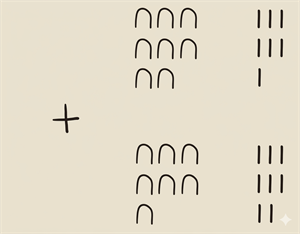
Add the following Egyptian numerals:
 
Gemini_Generated_Image_knqf4zknqf4zknqf.png
 
Solution:
 
Table value of Egyptian number system:

 
YCIND_260109_7871_Symbol (2).svg
 
Regrouping the number of 111333.png and YCIND_260123_7927_10.png we get,
 
\(15\) YCIND_260123_7927_10.png and \(15\) 111333.png
 
From the above table we get,
 
YCIND_260123_7927_10.png \(= 10\)
 
111333.png \( = 1\)
 
From the table we get, 
 
\(10\) YCIND_260123_7927_10.png \(=\)  YCIND_260123_7927_10^2.png
 
\(10\) 111333.png \(=\) YCIND_260123_7927_10.png
 
Thus we get,
 
 
\(15\) YCIND_260123_7927_10.png \(= 10 \)YCIND_260123_7927_10.png \(+\) \(5\) YCIND_260123_7927_10.png
 
\(=\)YCIND_260123_7927_10^2.pngYCIND_260123_7927_10.pngYCIND_260123_7927_10.pngYCIND_260123_7927_10.pngYCIND_260123_7927_10.pngYCIND_260123_7927_10.png  ------ (1)
 
\(= (10 + 5 ) \times 10\)
 
\( = (10 \times 10) + (5 \times 10)\)
 
\(15\) 111333.png \(=10 \)111333.png \(+\) \(5\) 111333.png
 
\(=\) YCIND_260123_7927_10.png 111333.png 111333.png 111333.png 111333.png 111333.png ------ (2)
 
Thus the sum of (1) and (2)
 
\(=\) YCIND_260123_7927_10^2.pngYCIND_260123_7927_10.pngYCIND_260123_7927_10.pngYCIND_260123_7927_10.pngYCIND_260123_7927_10.png
        YCIND_260123_7927_10.png YCIND_260123_7927_10.png 111333.png 111333.png 111333.png 111333.png 111333.png
 
 
Question 2:
 
Find the product of the following:

 
product of base.png
 
Solution:
 
From the table we get,
 
YCIND_260123_7927_10.png \(=10\)
 
product of base.png \(=10 \times 10\)
 
\(=10^{2}\)
 
\(=\)YCIND_260123_7927_10^2.png
 
Abacus that makes use of the Decimal system:
 
People once counted using stones, sticks, and marks on wood. Later, the abacus was developed as one of the earliest calculating devices for performing basic arithmetic operations like addition and subtraction. It also helps us understand the decimal (base-10) place value system.
The abacus helped people represent numbers using beads on rods.
 
image-a story of numbers.png
 
Each rod on an abacus represents a place value.
 
Bottom line: Units\((1s)\)
 
Second line: Tens\((10s)\)
 
Third line: Hundreds \((100s)\)
 
Fourth line: Thousands \((1000s)\)
 
To keep the board neat, each counter above a line has a value of \(5\), and each counter on or belwo the line has a value of \(1\).
Important!
 
Shortcomings of Egyptian system:
 
  • The Egyptian number system worked reasonably well for numbers up to a crore \((10^7)\), but beyond that, it bacame impracical because there was no simple way to extend it for very large numbers.
  • It needed a new symbol for every higher power of \(10\). That is, if the  numbers became larger, the system became harder to write and manage.
So, the next number system was developed to make writing numbers easier and calculations simpler.