

Long before modern numbers \((0-9)\) were invented, different ancient civilizations developed unique ways to count, measure, and record numbers. Let us explore three fascinating ancient numbering systems.
The Mesopotamian (Babylonian) Number System:
Ancient Mesopotamians developed a highly efficient mathematical system known as the sexagesimal system or Babylonian number system, which relies on base-\(60\) instead of our modern base-\(10\) (decimal) system.
Why Base-\(60\) (Sexagesimal)?
Astronomical Connections: It aligns closely with important natural cycles, such as their \(30\)-day lunar month or early tracking of the sun's revolution around the earth.
Ease of fractions: The number \(60\) has many factors \((1, 2, 3, 4, 5, 6, 10, 12, 15, 20, 30, 60)\), making division and fraction calculations incredibly smooth.
Cuneiform symbols:
They used a stylus to wedge-shaped marks into wet clay tablets. They only used two primary symbols to add up to any numbers under \(60\).
- A vertical wedge represented \(1\) \(-\)

- A corner wedge represented \(10\)\(-\)

Example:
Represent the large number \(640\).
Grouping it into landmark numbers, we see that
\(640 = 10 \times 60 + 40\)
\(= 10 \times\)  \(+ 4 \times \)
\(+ 4 \times \)\( = \)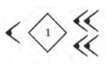
Place Value System:
For numbers \(60\) and above, they moved columns from right to left, multiplying each new position by a power of \(60\) (separated by a space):
- Right column: unit place \((\times 1)\)
- Left column: Sixties place \((\times 60)\)
Drawbacks of the Mesopotamian Number System:
- The same symbols were used in different place values, making some numbers difficult to interpret.
- Initially, there was no symbol for an empty place, so the value of a number could not be clear.
- Although a placeholder symbol (similar to zero)
 was introduced later, it was usually not written at the end of a number.
This limitation was one of the reasons why the modern zero became such an important improvement in place-value number systems.
The Mayan Number System:
The ancient Maya of Central America were brilliant mathematicians and astronomers. They developed an incredibly advanced numbering system to track time, manage trade, and calculate complex astronomical cycles.
Why almost a base-\(20\) number system?:
- Unlike our modern base-\(10\) system, the Mayans counted using both \(10\) fingers and \(10\) toes; because of this, their landmark number became \(20\).
- While a pure base-\(20\) system would scale up by multiplying by \(20\) each time \((1, 1\times 20 = 20, 20 \times 20 = 400, ...\)), but the Mayans have changed their rule at the third level. Their landmark numbers was \(1, 20, 20\times 18 = 360, 20^2 \times 18 = 7200, 20^3\times 18 = 144000,...\).
- Since the Mayan number system does not follow the base-\(20\) pattern completely, it is known as an almost base-\(20\) number system.
Three Simple Symbols (Numbers \(1\) to \(19\)):
They could write any number up to \(19\) using combinations of just two primary shapes along with a special shell shape for zero.
- A dot represented \(1\)

- A horizontal Bar represented \(5\)

- A shell shape for \(0\)

Vertical Place-Value System:
The Mayans wrote their numbers vertically from bottom to top. The bottom row represented \(1s\), the row above represented \(20s), the next row represented \(360s\), and the rows above represented larger place values.
Example:
Represent the number \(65\) in the Mayan number system.
\(65 = 3\times 20 + 5\times 1\)
To represent \(3\times 20 \), we draw three dots.
To represent \(5\times 1\), we draw one horizontal bar.
So, \(65\) can be expressed as  in the Mayan number system.
in the Mayan number system.Chinese Number System:
The ancient Chinese developed a highly advanced and practical mathematical tradition. Unlike the Mesopotamians (Base-\(60\)) or the Mayans (Base-\(20\)), the Chinese used a system much closer to our own, along with a brilliant tool for rapid calculation.
A Base-\(10\) (decimal) system:
Just like our modern system, the Chinese numbering system is entirely built on Base-\(10\).
Rod Numerals:
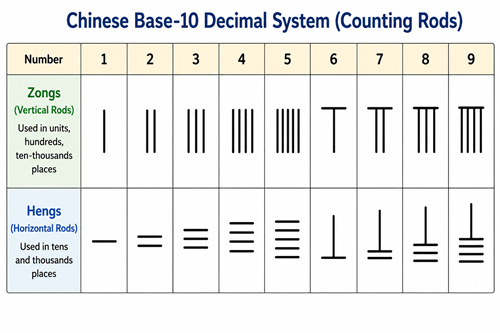
- Ancient Chinese mathematicians used counting rods (called chou) on a counting board to perform calculations.
- To make numbers easy to read, they arranged the rods in two different directions:
- Vertical rods (Zongs) were used for the units, hundreds, and ten-thousands places.
- Horizontal rods (Hengs) were used for the tens and hundreds places.
Example:
Represent the number \(41\) in the Chinese number system:
\(41 = 10(4) + 1\)
Since tens use the horizontal rods (Hengs) and ones use the vertical rods (Zongs), we have to use \(4\) horizontal rods followed by \(1\) vertical rod to represent the number \(41\).
That is, \(41\) can be represented as  in the Chinese number system.
in the Chinese number system.Handling zero with Blank Spaces:
- Like the Mesopotamians, the Chinese used a blank space to show an empty place value. But since the rod symbols for \(1\) to \(9\) were almost the same size, it was easier to identify the blank spaces.
- Later, they introduced a symbol for zero (\(〇\)), making their number system a complete place value system. Their number system is very similar to the Hindu–Arabic number system we use today.