

Ancient people used tally marks, sticks, pebbles, and symbols to count objects. As the numbers grew larger, these methods became more difficult and time-consuming.
To represent large numbers efficiently, civilisations developed systems based on grouping.
The Egyptians introduced an important idea:
Instead of counting one by one, count in groups of a fixed size.
This idea later developed into the concept of a base.
I. Egyptian Number System:
In this system, we see the use of landmark numbers to group and represent a given number. However, what makes this system special is its sequence of landmark numbers.
| \(1\) | \(10\) | \(10^2\) | \(10^3\) | \(10^4\) | \(10^5\) | \(10^6\) | \(10^7\) |
 |
 |
 |
 |
 |
 |
 |
 |
| Single Stroke |
Heel bone /
Inverted 'U'
|
Coiled rope | Lotus flower | Pointing finger | Tadpole | Astonished man / Lord of infinity | Sun |
Observe:
\(10 = 10 × 1\)
\(10^2 = 100 = 10 × 10\)
\(10^3 = 1000 = 10 × 100\)
Every landmark number is obtained by multiplying the previous landmark number by \(10\).
Hence, the Egyptian system is called a: Base-10 Number System.
Important!
Landmark numbers are special numbers used to build all other numbers in that system.
Representing Numbers in a Base System
To represent a number:
- Start with the largest landmark number smaller than the given number.
- Group the numbers using landmark numbers.
- Write the required combinations.
Example:
Represent \(243\) in Egyptian numerals.
\(243 = 100+100+10+10+10+10+1+1+1\)
Thus we get, \(243\) \(=\)  .
.
.II Variation on the Egyptian number system and notation of base:
Suppose every landmark number is multiplied by \(5\).
| Power | Landmark Number |
|---|---|
| \(5⁰\) | \(1\) |
| \(5¹\) | \(5\) |
| \(5²\) | \(25\) |
| \(5³\) | \(125\) |
| \(5⁴\) | \(625\) |

Every next landmark number is obtained by multiplying the previous landmark number by \(5\). The newly created base system is called Base-\(5\) Number System.
Example:
Represent \(112\) in Base-\(5\) system.
\(112=25+25+25+25+5+5+1+1\)
\(112\) = 
Important!
The Egyptian number system is a base - \(10\) system, and the number system that we created is a base - \(5\) system. A base - \(10\) number system is also called a \(\text{decimal number system}\).
Let us create a system to Base-\(7\):
Base-\(7\) Number System
Landmark numbers:
| Power | Value |
|---|---|
| \(7⁰\) | \(1\) |
| \(7¹\) | \(7\) |
| \(7²\) | \(49\) |
| \(7³\) | \(343\) |
| \(7⁴\) | \(2401\) |
General Rule for Any Base-\(n\) System
Number systems having landmark numbers in which the
(a) The first landmark number is \(1\), and
(b) Every next landmark number is obtained by multiplying the current landmark number by some fixed number \(n\), which is said to be \(\text{base-n}\) number system.
Landmark numbers are: \(n⁰\), \(n¹\), \(n²\), \(n³\), \(n⁴\), ...
Advantages of Base-\(n\) System
- Efficient Representation: Large numbers can be written using a few landmark numbers.
2. Easier Addition: Grouping follows a fixed pattern.
- Combine all identical symbols from both numbers.
- Whenever you collect \(10\) of the same symbol, exchange them for a single symbol of the next highest value—just like carrying a digit in modern column addition
3. Easier Multiplication: Products of landmark numbers are again landmark numbers.
- Multiplying by \(10\) is incredibly straightforward: simply swap each symbol for the next highest landmark symbol.
- Because of this base-10 structure, multiplying any two landmark numbers (powers of 10) always shifts them cleanly into a higher-value symbol.
4. Foundation of Modern Number Systems: Our Hindu Number System uses: Base \(10\) & Landmark numbers as powers of \(10\).
Abacus that Makes Use of the Decimal System:
Why Was the Abacus Needed?The Roman number system was useful for writing numbers, but performing calculations such as addition, subtraction, multiplication, and division was difficult.
To solve this problem, people used a calculating device called the abacus. The abacus allowed calculations to be performed more easily without writing long Roman numerals.
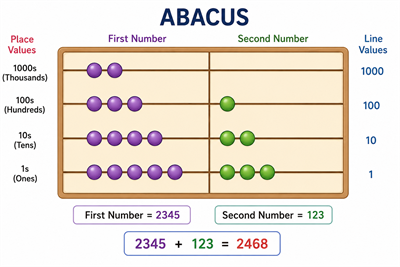
Adding numbers was simple! Just move the counters from both numbers together onto the same lines.
- The Rule of \(10\): If a line ever reached \(10\) counters, you had to remove them and add \(1\) single counter to the line right above it.
- Example: If you add \(7\) ones and \(3\) ones, you get \(10\) ones. You would take those \(10\) counters off the "\(1s\)" line and put \(1\) counter on the "\(10s\)" line instead.
This is exactly like the "carrying" method we use in school today when we add numbers in columns!
III. Shortcomings of the Egyptian System
Limitations of the Egyptian Number System:
The Egyptian system requires a separate symbol for each power of \(10\). As numbers become larger than \(10⁷\), new symbols must be created, making the system increasingly difficult to use. In this way, the challenge of representing large numbers remains unresolved.
The Egyptian system requires a separate symbol for each power of \(10\). As numbers become larger than \(10⁷\), new symbols must be created, making the system increasingly difficult to use. In this way, the challenge of representing large numbers remains unresolved.