

Fractions as Percentages :
You have surely seen a snack packet say 'Now with 25% extra!' or heard someone
say 'This milk is 100% pure.' But what does that little '%' sign actually mean?
This '%' symbol is read as per cent.
What does " Per Cent " mean?
The word comes from the Latin phrase "per centum". "Per cent" means " Out of
hundred."
Percentage: A fraction with denominator 100
A percentage is simply a fraction whose denominator is \(100\)
Example : \(20\%\) \(=\)
Why 100?
Our number system is based on \(10\). Using \(100\) makes it easy to convert
between fractions, decimals and percentages.
Expressing fractions as Percentages :
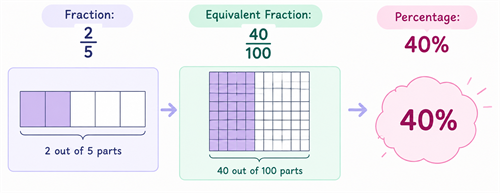
To express a fraction as a percentage, we find an equivalent fraction with
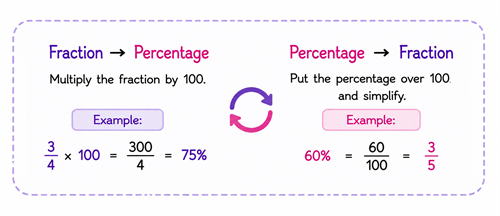
denominator 100 or multiply the fraction by 100.
Step 1: Start with the fraction
Step 2: Make equivalent fraction with denominator
Step 3: Read as percentage This means 40 out of every 100.
Step 4: Final answer
Expressing a Percentage as a Fraction :
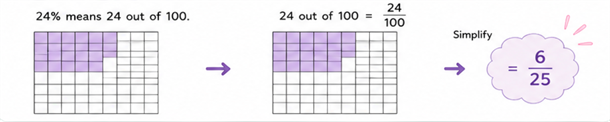
A percentage means " out of 100 " So, to write it as a fraction, write it over 100
and simplify.
Step 1: Start with the percentage \(24\%\)
Step 2: Write it over 100 (i.e.,)
Step 3: Simplify the fraction
Step 4: Final answer
Important!
Converstion Rule :
A Little History of Percentages :
- \(4^{th}\) century BCE, India: In his book Arthashastra, the scholar Kautilya wrote about interest rates on loans and the rates he described worked exactly like "per cent".
- Ancient Rome: Around the same time, Roman traders and auctioneers were charging taxes like \(\frac{1}{20}\) and \(\frac{1}{100}\) on their deals.
- \(15^{th}\) century, Italy: Merchants writing trade manuscripts used phrases such as 'xxp cento,' 'xp cento', and 'vil p cento', meaning " 20 per hundred", "10 per hundred" and "7 per hundred".