

The general form of a number in the Indian system using a set of letter-numbers will be as follows:
Any Number \(=\) \(… +10000e +1000d + 100c + 10b + a\)
Consider the five-digit number \(56193\) .
This can be written as \(56193 = edcba\)
\(56193 = 10000 \times e + 1000 \times 6 + 100 \times 1 + 10 \times 9 + 3\)
Recalling Divisibility:
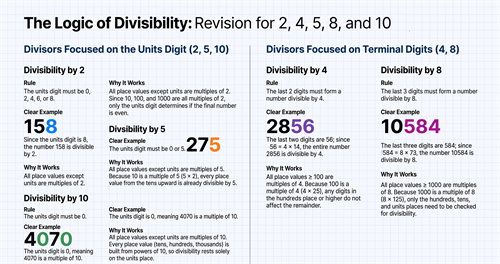
Some divisibility rules are based only on the last digit or the last few digits of a number.
These rules were learnt in earlier classes and will help us understand new shortcuts.
| Divisor | Quick Check |
|---|---|
| \(2\) | Last digit is \(0, 2, 4, 6\) or \(8\) |
| \(5\) | Last digit is \(0\) or \(5\) |
| \(10\) | Last digit is \(0\) |
| \(4\) | Last two digits form a multiple of \(4\) |
| \(8\) | Last three digits form a multiple of \(8\) |
A shortcut for Divisibility by \(9\):
Rule |
Why does it work? |
Add all the digits.
|
Every place value (1, 10, 100, 1000, …) leaves a remainder of \(1\) when divided by \(9\).
|
Let us see an example of why the rule of the sum of digits works for \(9\):
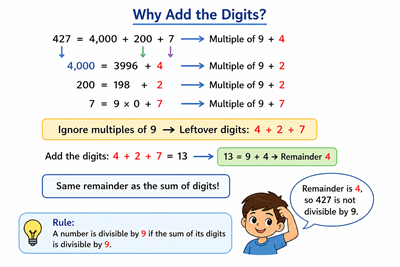
Divisibility Rule for \(9\): A number is divisible by \(9\) if and only if the sum of its digits is divisible by \(9\).
| Number | Sum of its digits | Divisible by \(9\)? |
| \(729\) | \(7+2+9 = 18\) | Yes |
| \(538\) | \(5+3+8 = 16\) | No |
| \(8532\) | \(8+5+3+2=18\) | Yes |
Conclusions:
- If a number is divisible by \(9\), then the sum of its digits is also divisible by \(9\).
- If the sum of the digits of a number is divisible by \(9\), then the number is also divisible by \(9\).
- If a number is not divisible by \(9\), then the sum of its digits is also not divisible by \(9\).
- If the sum of the digits of a number is not divisible by \(9\), then the number is also not divisible by \(9\).
A Shortcut for Divisibility by \(3\):
Divisibility by \(3\): Similar to \(9\), a number is divisible by \(3\) if the sum of its digits is divisible by \(3\).
Rule |
Why does it work? |
Add all the digits.
|
Every place value (1, 10, 100, 1000, …) leaves a remainder of \(1\) when divided by \(3\).
|
| Number | Sum of its digits | Divisible by \(3\)? |
| \(582\) | \(5+8+2 = 15\) | Yes |
| \(541\) | \(5+4+1 = 10\) | No |
A Shortcut for Divisibility by \(11\) (Alternating Sum):
Divisibility rule for \(11\): Place alternating '\(+\)' and '\(−\)' signs before the digits, starting from the units digit. Evaluate the expression. If the result is \(0\) or a multiple of \(11\), the number is divisible by \(11\).
| Rule | Why does it work? |
|---|---|
| Add the digits in alternate places and find the difference between the two sums. If the difference is \(0\) or a multiple of \(11\), then the number is divisible by \(11\). |
Every place value alternates between \(1\) more and \(1\) less than a multiple of \(11\).
\(1 = 0 × 11 + 1\)
\(10 = 1 × 11 − 1\)
\(100 = 9 × 11 + 1\)
\(1000 = 91 × 11 − 1\)
\(10000 = 909 × 11 + 1\)
Therefore, the place values contribute alternately as \(+\) digit and \(−\) digit. The remaining parts are multiples of \(11\) and can be ignored. Hence, the remainder obtained when a number is divided by \(11\) is the same as the remainder obtained from the difference between the sums of the alternating digits.
|
| Number | Alternating Sum | Divisible by \(11\)? |
| \(137269\) |
\(-1+3-7+2-6+9\)
\(=(3+2+9)-(1+7+6)\)
\(=14-14 =0\)\
|
Yes |
| \(66311\) |
\(6-6+3-1+1\)
\(= (6+3+1)-(6+1)\)
\(=10-7 =3\)
|
No |
More on Divisibility Shortcuts (\(6\) and \(24\))
Divisibility by \(6\): A number must satisfy the rules for both \(2\) and \(3\).
| Number | Check for Divisibility by \(6\) | Divisible by \(6\)? |
|---|---|---|
| \(732\) |
Last digit \(= 2\) - (Divisible by \(2\))
Digit sum \(= 7 + 3 + 2 = 12\) - (Divisible by \(3\))
|
Yes |
| \(454\) |
Last digit \(= 4\) (Divisible by \(2\))
Digit sum \(= 4 + 5 + 4 = 13\) - (Not divisible by \(3\))
|
No |
Divisibility by \(24\): A number must be divisible by \(3\) and \(8\).
| Number | Check for Divisibility by \(24\) | Divisible by \(24\)? |
|---|---|---|
| \(1944\) |
Digit sum \(= 1 + 9 + 4 + 4 = 18\) - (Divisible by \(3\))
Last three digits \(= 944\); \(944 ÷ 8 = 118\) - (Divisible by \(8\))
|
Yes |
| \(1548\) |
Digit sum \(= 1 + 5 + 4 + 8 = 18\) - (Divisible by \(3\))
Last three digits \(= 548\); \(548÷ 8 = 68\) with remainder \(4\) - (Not divisible by \(8\))
|
No |
Important!
Checking \(4\) and \(6\) is insufficient because \(12\) is divisible by both but not by \(24\).