

Let us recall the concepts of multiples, factors and expressions based on them.
A factor of a number divides it exactly without leaving any remainder.
A multiple is obtained by multiplying a number by a whole number.
Important!
An expression of the form \(kn\) represents all multiples of \(k\), where \(n\) is a whole number. For example, \(6n\) represents all multiples of \(6\).
Pairs to Make Four - Divisibility rule for \(4\)
When an even number is divided by \(4\), it can leave only two possible remainders.
| Type 1 - Multiples of \(4\) |
Type 2 - Even Numbers that are not Multiples of \(4\)
|
| These numbers leave a remainder of \(0\) when divided by \(4\). Examples \(8\), \(12\), \(20\), \(28\), \(40\), \(52\), … These numbers can be written as: \(4n\) where \(n\) is a whole number. |
These numbers leave a remainder of \(2\) when divided by \(4\).
Examples \(2\), \(10\), \(18\), \(26\), \(34\), \(42\), … These numbers can be written as: \(4n + 2\) where \(n\) is a whole number. |
|
Visualization:
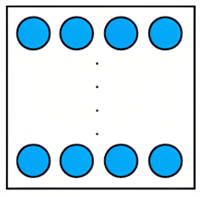 Even numbers that are multiples of \(4\) leave a remainder of \(0\) when
divided by \(4\) |
Visualization:
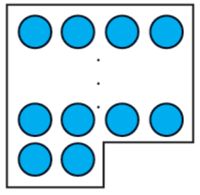 Even numbers that are not multiples of \(4\) leave a remainder \(2\) when divided by \(4\).
|
Explore the Pattern
Add two even numbers and observe whether their sum is a multiple of \(4\).
Add two even numbers and observe whether their sum is a multiple of \(4\).
| Situation | Algebraic Representation | What do you observe? | Example |
|---|---|---|---|
| Both numbers are multiples of \(4\) | (\(4a+4b\) \(=4(a+b)\)) | ✅ The sum is always divisible by \(4\). | (\(20+12=32\)) - Multiple of \(4\) |
| Both numbers leave remainder \(2\) when divided by \(4\) | (\((4a+2)+(4b+2)\) \(=4(a+b+1)\)) | ✅ The sum is again divisible by \(4\). | (\(18+10=28\)) -Multiple of \(4\) |
| One number is a multiple of \(4\) and the other leaves remainder \(2\) | (\(4a+(4b+2)\) \(=4(a+b)+2\)) | ❌ The sum is even, but not divisible by \(4\). | (\(16+10=26\)) - Not a multiple of \(4\) |
Important!
The sum of two even numbers is a multiple of \(4\) only when:
- both numbers are multiples of \(4\), or
- both numbers leave a remainder of \(2\) when divided by \(4\).
If one number is from each type, the sum is not a multiple of \(4\).