

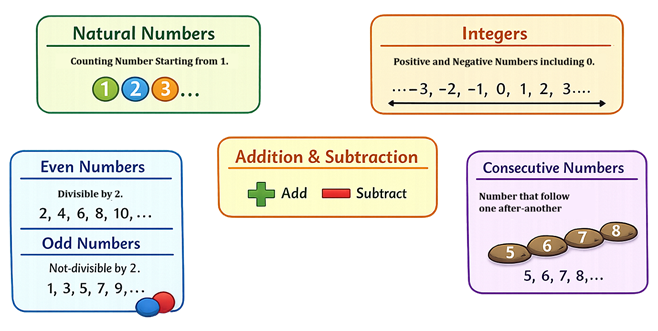
Let us recall about numbers:
Sum of Consecutive Numbers:
Can a Number Be Written as a Sum of Consecutive Numbers?
Many numbers can be expressed as the sum of consecutive numbers.
For example:
- \(9 = 4 + 5\)
- \(18 = 5 + 6 + 7\)
- \(30 = 4 + 5 + 6 + 7 + 8\)
- \(15 = 7 + 8 = 4 + 5 + 6 = 1 + 2 + 3 + 4 + 5\) (Some numbers can even be written in more than one way.)
This shows that a single number may have different consecutive number representations.
But not every natural number can be written as a sum of consecutive natural numbers.
For example:
- \(2\)
- \(4\)
- \(8\)
- \(16\)
These numbers cannot be expressed as the sum of two or more consecutive natural numbers.
Interesting Facts about consecutive odd numbers:
Odd Numbers: Every odd number can be written as the sum of two consecutive natural numbers. Examples: \(5 = 2 + 3\), \(9 = 4 + 5\), \(17 = 8 + 9\), \(25 = 12 + 13\).
Even Numbers: Some even numbers can be written as sums of consecutive numbers.
Examples: \(6 = 1 + 2 + 3\), \(10 = 1 + 2 + 3 + 4\), \(14 = 2 + 3 + 4 + 5\)
But not all even numbers can. For example: \(2\), \(4\), \(8\), \(16\) cannot be expressed as the sum of consecutive natural numbers.
Powers of \(2 (2, 4, 8, 16, …)\) cannot be written as the sum of consecutive natural numbers.
Why does this happen?
The sum of consecutive natural numbers requires that the number have a suitable combination of factors. Powers of \(2\) have only one odd factor, namely \(1\), so such a combination is not possible.
We do not need proof for this. At this stage, it is enough to observe the pattern through examples. In higher classes, we will learn the mathematical proof behind this interesting property.
Magic of \(+\) and \(-\) with \(4\) consecutive numbers:
Let's take four consecutive numbers as \(3\), \(4\), \(5\) and \(6\).
Now, we place \(+\) or \(-\) signs between them.
- \(3 + 4 + 5 + 6 = 18\)
- \(3 + 4 + 5 - 6 = 6\)
- \(3 + 4 - 5 + 6 = 8\)
- \(3 - 4 + 5 + 6 = 10\)
- \(3 - 4 - 5 + 6 = 0\)
- \(3 + 4 - 5 - 6 = -4\)
- \(3 - 4 + 5 - 6 = -2\)
- \(3 - 4 - 5 - 6 = -12\)
Here, note that the sum of all possible consecutive numbers is even.
Thus, the sum of any four consecutive numbers is even.
What do you notice?
No matter which four consecutive numbers you choose or how you arrange the \(+\) and \(–\) signs, the answer is always an even number.
This interesting property is called even parity.
Why is it always even?
1. Sign Switched: Let us consider any of the 8 expressions formed from the four numbers \(a\), \(b\), \(c\), and \(d\). When one of its signs is switched, its value always increases or decreases by an even number!
For example: \(+b → –b\), the difference becomes \(b-(-b) = 2b\) which is even.
2. Parity: We know that,
odd \(\pm\) odd \(=\) even
even \(\pm\) even \(=\) even
odd \(\pm\) even \(=\) odd
In short, \(a ± b\) have the same parity. By the same argument, \(a ± b + c\) and \(a ± b – c\) have the same parity. Extending this further, we can say that all the expressions \(a ± b ± c ± d\) have the same parity.
Important!
This pattern is true for any set of consecutive numbers, not just four.
When you place \(+\) and \(–\) signs in different ways, all the answers have the same parity. They are either all even or all odd.