

Let us recall about numbers:
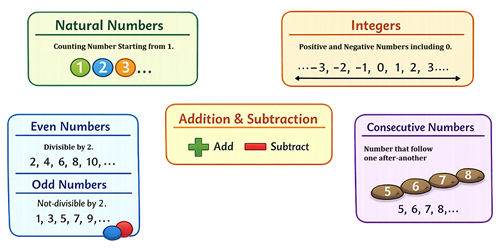
General form of consecutive numbers:
- Any consecutive number can be written as \(x\), (\(x + 1\)), (\(x + 2\)), (\(x + 3\)), ....
- Any even consecutive number can be written as \(2x\), \(2x + 2\), \(2x + 4\), ....
- Any odd consecutive number can be written as \(2x+1\), \(2x + 3\), \(2x + 5\), ....
Always, Sometimes and Never True
Look at the following statements about factors and multiples. Decide whether each statement is:
Always True – true in every case.
Sometimes True – true only for some cases.
Never True – not true in any case
Always True – true in every case.
Sometimes True – true only for some cases.
Never True – not true in any case
Results on divisibility rule:
Result 1: If \(a\) divides \(M\) and \(a\) divides \(N\), then \(a\) divides \(M+N\) and \(a\) divides \(M–N\).
Result 2: If \(A\) is divisible by \(k\), then all multiples of \(A\) are divisible by \(k\).
Result 3: If \(A\) is divisible by \(k\), then \(A\) is divisible by all factors of \(k\).
Result 4: If \(A\) is divisible by \(k\) and \(A\) is also divisible by \(m\), then \(A\) is divisible by the LCM of \(k\) and \(m\).
Algebraic Representation of Number:
1. If a number leaves a remainder \(r\) when divided by \(d\), then all such numbers can be written as \(dk+r\) with \(k≥0\) or \(dk−(d−r)\) with \(k≥1\).
2. If a number leaves the same remainder \(r\) when divided by \(a\) and \(b\), then Number \(=\) LCM\((a,b)×k+r\).
Divisiblity rules of numbers:
| Number | Divisibility rule | Example |
| \(2\) | If the number ends at \(2\), \(4\), \(6\), \(8\) or \(0\), it is divisible by \(2\). | \(14\), \(28\), \(100\) are end with \(4\), \(8\) and \(0\). So, these are divisible by \(2\). |
| \(3\) | If the sum of the digits of the number are divisible by \(3\), then that number is divisible by \(3\). | Consider the number \(681\). In this, the sum of the digits \(= 6 + 8 + 1 = 15\) \(\frac{15}{3} = 5\) Thus, \(681\) is divisible by \(3\). |
| \(4\) | If a last two digits of any number are divisible by \(4\), then that number is divisible by \(4\). | Consider the number \(248\). In this, the last two digits are \(48\). \(\frac{48}{4} = 12\) Thus, \(248\) is divisible by \(4\). |
| \(5\) | If a digit in the ones place of a number is \(5\) or \(0\), then it is divisible by \(5\). | Consider the number \(3270\). In this, the last digit is \(0\). Thus, \(3270\) is divisible by \(5\). |
| \(8\) | A number is divisible by \(8\) if the number formed by its last three digits is divisible by \(8\). | Consider the number \(35416\) Consider the last three digits \(416\). Here, \(\frac{416}{8} = 52\). Since \(416\) is divisible by \(8\), the number \(35416\) is divisible by \(8\). |
| \(9\) |
A number is divisible by \(9\) if the sum of its digits is divisible by \(9\).
Sometimes, if the sum is large, keep adding the digits of the sum until you get a number less than \(9\) or equal to \(9\), then check divisibility.
|
Consider the number \(987450633\). Sum of the digits \(= 9 + 8 + 7 + 4 + 5 + 0 + 6 + 3 + 3 = 45\) Again adding the result \(= 4 + 5 = 9\) which is divisible by \(9\) Thus, the number \(987450633\) is divisible by \(9\). |
| \(10\) | A number is divisible by \(10\), if it ends with \(0\). | Consider the number \(3320\). In this, the last digit is \(0\). Thus, \(3320\) is divisible by \(10\). |
| \(11\) | A number is divisible by \(11\) if the difference between the sum of its digits in odd positions and the sum of its digits in even positions is either \(0\) or a multiple of \(11\). | Consider the number \(378301\). Sum of digits in even places \(= 3 + 8 + 0 = 11\) Sum of digits in odd places \(=7 + 3 + 1 = 11\) Difference \(= 11 - 11 = 0\) Thus, the number \(378301\) is divisible by \(11\). |
More on Divisibility Rules:
Divisibility by \(6\):
If a number is divisible by \(2\) and \(3\), then that number is divisible by \(6\).
Divisibility by \(12\):
A number is divisible by \(12\) if and only if it is divisible by \(3\) and \(4\).
Divisibility by \(18\):
If a number is divisible by \(2\) and \(9\), then that number is divisible by \(18\). That is, the number must be even, and the sum of its digits must be divisible by \(9\).
Divisibility by \(24\):
If a number is divisible by \(3\) and \(8\), then that number is divisible by \(18\). That is, the sum of its digits must be divisible by \(3\), and its last three digits must form a number divisible by \(8\).