

Digital Roots
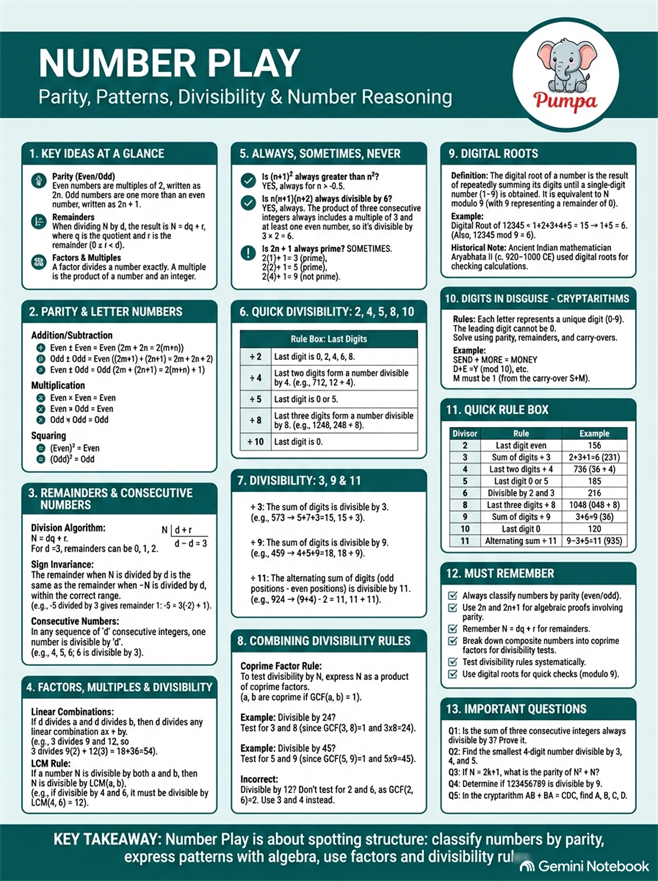
The digital root in math is the single-digit value obtained by continuously summing the digits of a number until only one digit remains.
How Digital Roots Work?
Start by adding the digits of a number.
If the result has more than one digit, repeat the process with the new sum.
Continue until a single-digit number is reached.
For example, for \(67392\): \(6 + 7 + 3 + 9 + 2 = 27\) then, \(2 + 7 = 9\). So, the digital root is \(9\).
The digital root of multiples of \(9\) is \(9\).
Digits in Disguise
Digits in disguise means letters or symbols are used instead of numbers (digits) in a math problem or puzzle. Each letter stands for one number from \(0\) to \(9\). The goal is to find which digit each letter represents.
How to Solve Digits in Disguise?
- Remember each letter is one number, always the same number wherever it appears.
- Different letters stand for different numbers.
- Use simple math rules to guess which numbers fit.2
- Check if the sum or product is right after you guess.