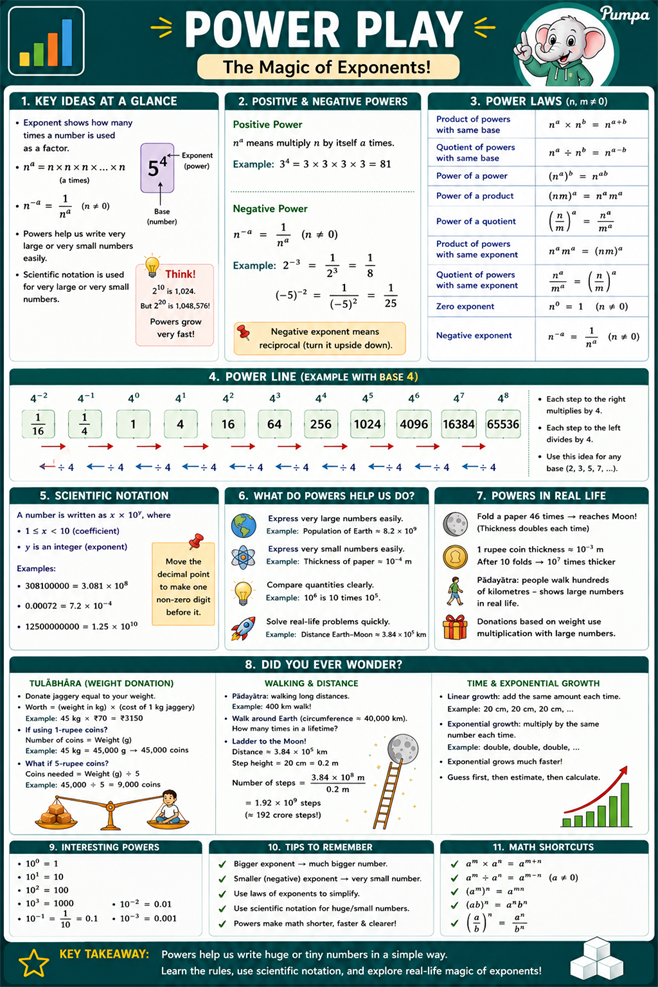
1. Power of 10:
Powers of \(10\) can be used to explain larger values in expanded form, and decimal values can be expressed using powers of \(10\).
Example: \(47561\)
\(=(4 \times 10000) + (7 \times 1000) + (5 \times 100) + (6 \times 10) + (1 \times 1)\)
\(=(4 \times 10^{4}) + (7 \times 10^{3}) + (5 \times 10^{2}) + (6 \times 10^{1}) + (1 \times 10^{0})\)
2. Scientific Notation:
In scientific notation, we write numbers as \(x \times 10^{y}\), where \(x \geq1\) and \(x<10\) is the coefficient and \(y\), is the exponent,is any integer.
Scientific notation is very useful in expressing large values using power of \(10\).
Example: \(3430000 = 3.43 \times 10^{6}\)
3. Did you ever wonder?
Tulabhara or Tulabharam:
The practice of offering goods equal to the weight of a person, called Tulabhara or Tulabharam, is quite old and is still followed in many places in Southern India. It is a symbol of bhakti (surrendering oneself), a token of gratitude; it also supports the community.
Padayatra:
Padayatra, is the traditional practice of walking long distances as part of a religious or spiritual pursuit. People across religions in our country observe similar forms of pilgrimage or spiritual walking, although they may have different names or purposes.
Solution:
Walking speed \(= 5 km/h\); Lifetime \(= 80\) years; Distance around Earth \(= 40,000\) \(km\)
Distance walked in one day \(= 5\times24 = 120\) \(km/day\)
Distance walked in one year \(= 120 \times 365 = 43,800\) \(km\)
Distance walked in \(80\) years \(43,800 \times 80 = 3,504,000\) \(km\)
Number of times around Earth \(= \frac{3,504,000}{40,000} = 87.6 \approx 88\)
A person walking non-stop at \(5 km/h\) for \(80\) years could theoretically circumnavigate the Earth about \(88\) times.
4. Linear Vs Exponential Growth:
Linear Growth: Repeated addition of constant value
Exponential Growth: Repeated multiplication of constant value
Example: To cover the distance between Earth and Moon
With linear growth it takes \(1,92,20,00,000\) steps with each step is \(20 \ cm\) gain.
With exponential growth it takes \(46\) folds of a piece of paper.
5. Very Large Numbers & Order of Magnitude:
Scientific notation is used to express larger quantities.
Example: Stars in Universe: \(2 \times 10^{23}\)
s