

Why Do We Need Ratios?
We compare many quantities in our daily life. For example:
- Number of boys and girls in a class
- Pens and pencils in a pencil box
- Width and height of an image
- Length and breadth of a playground
Instead of comparing the quantities only by their difference, a ratio tells us how one quantity compares with another.
Observing Similar Images
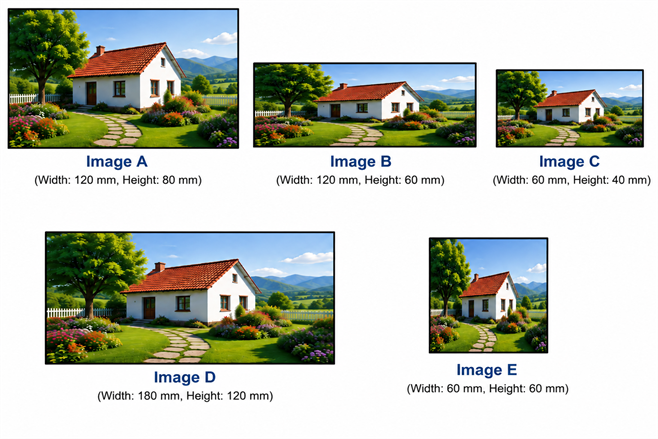
Observe carefully:
- Images \(A\), \(C\) and \(D\) look similar even though their sizes are different.
- Images \(B\) and \(E\) look different because they appear stretched or compressed.
Why?
| Image | Dimensions | Change |
| Image \(A\) | Width \(=\) \(120 \ mm\) and Height \(= 80 \ mm\) | Original image |
| Image \(C\) | Width \(=\) \(60 \ mm\) and Height \(= 40 \ mm\) | Comparing to image \(A\), the dimensions are half of the original image. |
| Image \(D\) | Width \(=\) \(180 \ mm\) and Height \(= 120 \ mm\) | Comparing to image \(A\), the dimensions are one and half times the original image. |
Image \(C\): The width \((60 \ mm\)) is half of \(A\) \((120 \ mm)\), and the height \((40 \ mm)\) is half of \(A\) \((80 \ mm)\). Both dimensions are multiplied by the same factor \((\frac{1}{2})\).
Image \(D\): The width \((180 \ mm\)) and the height \((120 \ mm)\) are both multiplied by the same factor \((\frac{3}{2})\).
Thus, multiplying both dimensions by the same factor keeps the image in proportion.
Image \(B\): Subtracting \((20 \ mm\)) from both dimensions gives a width of \((100 \ mm\)) and a height of \((60 \ mm\)). Although \((20 \ mm\)) was subtracted from both, the height became half, but the width did not become half. Subtraction does not preserve shape.
Image \(D\): The width \((60 \ mm\)) is half of \(A\), but the height \((60 \ mm)\) is not half of \(A\).
Thus, changing dimensions by subtraction or using different multiplicative factors distorts the image, making it look stretched or compressed.
In mathematics, when we compare two quantities like width and height to see how they relate, we use a Ratio.
What is Ratio?
A ratio compares two quantities of the same kind. It is written using the symbol \(" : "\).
The ratio of two quantities \(a\) and \(b\) are termed as \(a:b\), where \(a\) is called the first term or antecedent and \(b\) is called the second term or consequent.
Any ratio \(a:b\) can be pronounced as \(a\) is to \(b\).
It also can be written as \(a\) to \(b\) or \(a/b\).
Equivalent Ratios:
In the above images, images \(A\), \(C\) and \(D\) multiplied by the same factor \(\frac{3}{2}\).
The ratios multiplied by the same factor are called an equivalent ratios.
For example, \(25 : 15\) and \(20 : 12\) are equal ratios since both have same factor \(\frac{5}{3}\).
The ratios which are not multiplied by the same factor are called not equivalent ratios.
Ratios in Their Simplest Form:
Sometimes, different ratios represent the same comparison. To compare them easily, we write each ratio in its simplest form.
A ratio is said to be in its simplest form when its two terms have no common factor other than \(1\).
How to Find the Simplest Form?
- Find the Highest Common Factor (HCF) of both terms.
- Divide both terms of the ratio by the HCF.
Examples
| Ratio | HCF | Simplest form |
| \(60 : 40\) | \(20\) | \(3 : 2\) |
| \(30 : 20\) | \(10\) | \(3 : 2\) |
| \(45 : 15\) | \(15\) | \(3 : 1\) |
Proportional Ratios
When two ratios have the same simplest form, they are said to be in proportion or proportional.
We use the symbol \(::\) to show proportion.
\(a : b :: c : d\)
It is read as, "\(a\) is to \(b\) as \(c\) is to \(d\)".