

Visual Proportionality:
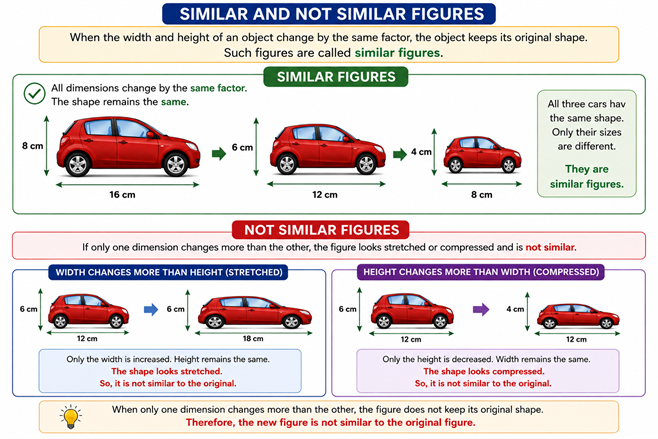
We already learned this in the earlier class.
Proportion:
Two ratios are said to be in proportion if they are equal in their simplest forms. We use the symbol \(::\) to show that they are proportional. So, \(a : b :: c : d\) indicate that they are proportional. It means \(a : b = c : d\).
Example:
Check whether the given ratios are in proportion.
\(2:4\) and \(8:16\).
Reducing the first ratio to the simplest form by dividing each term by the HCF.
\(2:4\) and \(8:16\).
Reducing the first ratio to the simplest form by dividing each term by the HCF.
Reducing the second ratio to the simplest form by dividing each term by the HCF.
Here the simplest form of the given ratios are equal. Thus, the two ratios are in proportion.
Rule of Three:
Use the Rule of Three when:
\(✔\) Two quantities increase or decrease together in the same proportion.
\(✔\) Three quantities are known, and the fourth quantity is to be found.
\(✔\) The relationship between the quantities remains constant.
Foundation of Rule of Three:
Consider two proportional ratios \(a : b\) and \(c : d\).
Method A: The Scaling Factor Approach
If two ratios are proportional, the target quantities are obtained by multiplying the base quantities by a common factor of change \((f)\).
\(c = f \cdot a\) \(\implies f = \frac{c}{a}\)
\(d = f \cdot b\) \(\implies f = \frac{d}{b}\)
Equating the two expressions of \(f\):
\(\frac{c}{a} = \frac{d}{b}\)
Method B: Cross Multiplication
\(\frac{c}{a} = \frac{d}{b}\)
Multiply both sides by \(a \cdot b\).
\(ab \times \frac{c}{a} = ab \times \frac{d}{b}\)
\(bc = ad\) or \(ad = bc\)
This is called Cross Multiplication.
If one value is unknown, then:
\(d = \frac{bc}{a}\)
This formula helps us find the missing quantity quickly.
The Product Rule of Proportion:
Two ratios are proportional if and only if the product of the extremes \((a \cdot d)\) equals the product of the means \((b \cdot c)\).
Two ratios are proportional if and only if the product of the extremes \((a \cdot d)\) equals the product of the means \((b \cdot c)\).
Sharing, but not equally:
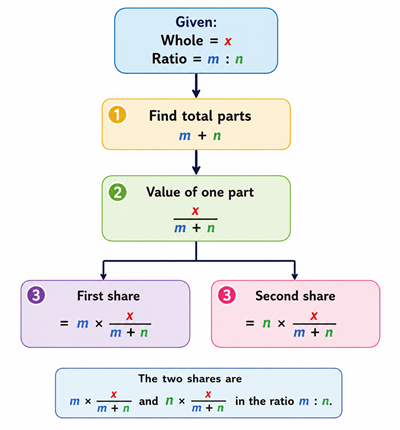
Riya and Aman have \(12\) counters. They want to share them between themselves.
Suppose they want to share the \(12\) counters in the ratio \(3 : 1\).
This means, Riya gets \(3\) parts and Aman gets \(1\) part.
So, the total number of parts is:
\(3 + 1 = 4\)
Now, divide the \(12\) counters into \(4\) equal parts to find the value of one part.
\(12 \div 4 = 3\)
Therefore,
Riya gets \(= 3 \times 3 = 9\) counters
Second gets \(= 1 \times 3 = 3\) counters
General Rule: