

1. Understanding Division of a Whole in a Given Ratio
We have already learnt how to divide a quantity into two or more parts in a given ratio. We can extend the same method to ratios with two, three, or more terms.
When a whole quantity is divided in a given ratio, each part represents a specific number of equal units, or parts, of the whole.
Example:
Suppose a ribbon of length \(24 \ cm\) is divided between two students in the ratio \(3 : 5\).
This means:
-
The first student receives \(3\) equal parts.
-
The second student receives \(5\) equal parts.
The total number of parts is \(3 + 5 = 8\)
Value of one part \(= \frac{24}{8} = 3 \ cm\)
Thus, first student's share \(= 3 \times 3 = 9 \ cm\)
Second student's share \(= 3 \times 5 = 15 \ cm\)
Therefore, \(24 \ cm\) ribbon is divided in the ratio \(3 : 5\) gives \(9 \ cm\) and \(15 \ cm\).
2. Dividing a Whole into Three or More Parts
The method of dividing a whole in a given ratio is not limited to two quantities. We can divide a whole into three, four or more parts using the same approach.
Example:
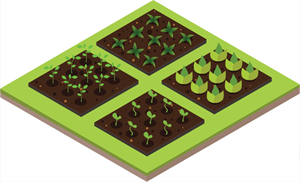
A school has \(84\) saplings to be planted in three gardens. The saplings are to be distributed among the gardens in the ratio \(2 : 3 : 7\). Find the number of saplings allotted to each garden.
Solution:
The given ratio is \(2 : 3 : 7\).
Step 1: Find the total number of parts.
\(2 + 3 + 7 = 12\)
Step 2: Find the value of one part.
\(\frac{84}{12} = 7\)
Step 3: Calculate each share.
First garden \(= 2 \times 7 = 14\) saplings
Second garden \(= 3 \times 7 = 21\) saplings
Third garden \(= 7 \times 7 = 49\) saplings
3. Dividing a Whole into Parts When the Ratio Contains Fractions or Decimals
Sometimes, the terms of a given ratio may contain fractions or decimals. You can use the same method to divide the whole. First, add all the terms of the ratio, then divide the total quantity by their sum to find the value of one part.
Example:
The quantities of three ingredients in a cake are in the ratio, flour \(:\) cocoa powder \(:\) baking powder \(= 10.5 : 5.5 : 2\). If the total weight of the cake is \(9 \ kg\), find the quantities of the three ingredients.
Solution:
Given ratio is \(10.5 : 5.5 : 2\).
Step 1: Find the total number of parts.
\(10.5 + 5.5 + 2 = 18\)
Step 2: Find the value of one part.
One part \(= \frac{9}{18} = 0.5\)
Step 3: Find the quantity of each ingredient.
Flour: \(10.5 \times 0.5 = 5.25 \ kg\)
Cocoa powder: \(5.5 \times 0.5 = 2.75 \ kg\)
Baking powder: \(2 \times 0.5 = 1 \ kg\)
4. General Formula for Dividing a Whole in a Given Ratio
If a quantity \(x\) is divided in the ratio \(a : b : c : d : ....\), then the total number of parts is \(a + b + c + d + ....\).
The respective shares are:
First share \(= x \times \frac{a}{a + b + c + d + ....}\)
Second share \(= x \times \frac{b}{a + b + c + d + ....}\)
Third share \(= x \times \frac{c}{a + b + c + d + ....}\)
Fourth share \(= x \times \frac{d}{a + b + c + d + ....}\)
The process continues for any number of terms.