

1. Proportionality
Ratio:
A ratio is a comparison of two or more quantities of the same kind by division. It shows how much of one quantity there is compared with another. A ratio is written using the symbol \(:\).
Example: An art club uses \(3\) cups of yellow paint and \(2\) cups of blue paint to prepare a particular shade of green. What is the ratio of yellow paint to blue paint?
Solution:
The ratio of yellow paint to blue paint is \(3 : 2\).
Understanding proportional relationships:
A proportional relationship exists between two quantities when they change by the same factor. In other words, if one quantity is multiplied or divided by a number, the other quantity is also multiplied or divided by the same number.
Example: Meera mixes lemon squash in the ratio \(3 : 5\) (concentrate \(:\) water) and Dev uses \(9 : 15\). Will both of their lemon juices taste the same?
Solution:
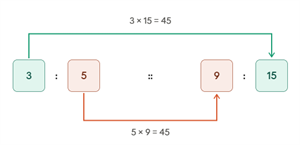
Since the cross-products are equal, the ratios are proportional.
Therefore, their lemon juices tastes the same.
Important!
Two ratios \(a : b\) and \(c : d\) are proportional if:
\(a \times d = b \times c\)
or
\(\frac{a}{b} = \frac{c}{d}\)
2. Ratios in maps
A map represents a large geographical area on a smaller surface, such as a sheet of paper or a screen.
The Representative Fraction (RF), also called the map ratio, expresses the relationship between a distance measured on a map and the corresponding actual distance on the ground.
\(RF =\) Map distance \(:\) Actual distance on the ground
Finding the actual distance using a map ratio
To calculate the actual distance between two places:
1. Measure the distance between the places on the map using a ruler.
2. Identify the representative fraction.
3. Multiply the map distance by the scale factor.
4. Convert the result into a suitable unit, if necessary.
Geographical distance:
The straight-line distance between two locations. It is the shortest distance and is usually measured using a map's representative fraction(RF).
Road distance:
The distance travelled along roads between two locations. It can be longer than the geographical distance because roads may curve, take indirect routes or go around obstacles.
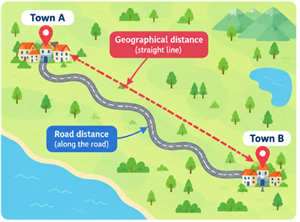
Note: The distance calculated using a map ratio is the geographical distance, not the road distance.
Example:
Find the distance between Melbourne and Sydney using the given map of Australia.
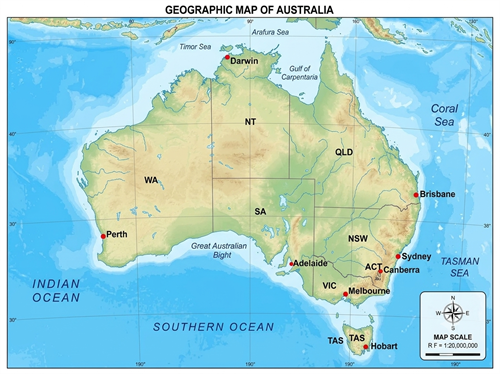
Step 1: Using a ruler, the distance between Melbourne and Sydney is \(3.5 \ cm\) on the map.
Step 2: \(RF = 1 : 20,000,000\)
Step 3: \(3.5 \times 20,000,000 = 70,000,000 \ cm\)
Important!
| Conversion | Value |
| \(1 \ m\) |
\(100 \ cm\)
|
| \(1 \ km\) | \(1000 \ m\) |
To turn a distance in \(cm\) into \(km\), divide by \(100,000\).