

We often share things in our daily life — like chocolates among friends, money among team members, or work among people. When we share equally, everyone gets the same amount. But sometimes, we share unequally, depending on some condition or given ratio (like work done, marks scored, or money invested). This is called sharing in a ratio.
The ratio tells us how many parts each person receives.
Activity:
Riya and Aman have \(12\) counters. They want to share them between themselves.
First: Share Equally
If they share the \(12\) counters equally:
\(12 \div 2 = 6\)
So, Riya : Aman \(=\) \(6 : 6 = 1 : 1\)
Second: Share Unequally
Suppose they want to share the \(12\) counters are to be shared in the ratio \(3 : 1\).
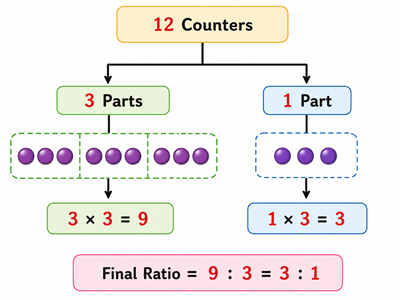
This means, Riya gets \(3\) parts and Aman gets \(1\) part.
So, the total number of parts is:
\(3 + 1 = 4\)
Now, divide the \(12\) counters into \(4\) equal parts to find the value of one part.
\(12 \div 4 = 3\)
Therefore,
Riya gets \(= 3 \times 3 = 9\) counters
Second gets \(= 1 \times 3 = 3\) counters
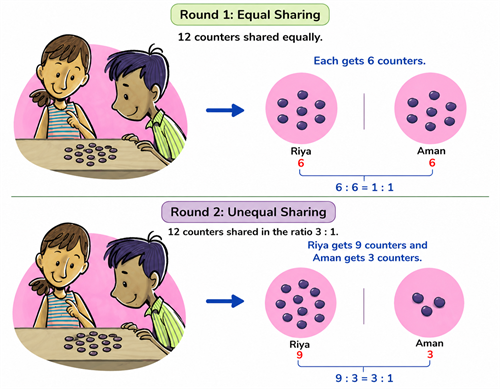
Check: \(9 + 3 = 12\)
\(9 : 3 = 3 : 1\)
Therefore, \(12\) counters are shared as \(9\) and \(3\).
General Rule:
Procedure for unequal sharing (in a ratio):
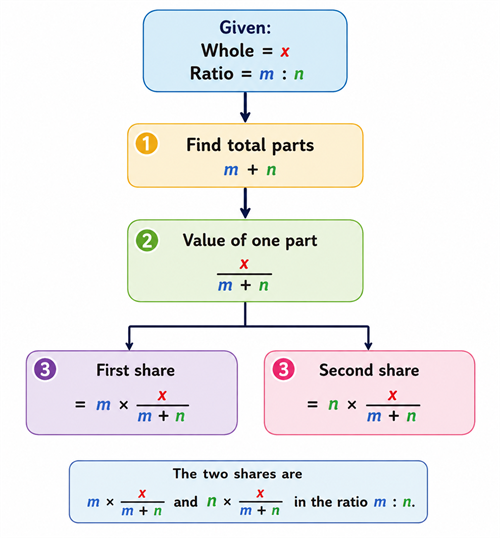
Step 1: If the given ratios are \(a : b: c: ...\), then add the total parts as \(a + b + c + ...\)
Step 2: Divide the total amount by total parts to get the value of one part.
\(\text{Value of one part} = \frac{\text{Total amount}}{\text{Total parts}}\)
Step 3: Multiply the value of one part by each person's part in the ratio.
\(\text{Share of the person } \ 'a' = \ 'a' \times \text{Value of one part}\)
Example:
Share \(₹ 600\) in the ratio of \(3 : 5\).
Solution:
Total parts \(= 3 + 5 = 8\)
First share \(=\) \(\frac{600}{8} \times 3 = ₹225\)
Second share \(=\) \(\frac{600}{8} \times 5 = ₹375\)
Important!
If you add each part of the share, it must be equal to the total amount.