

The Angle Sum Property is a fundamental rule in geometry which states that the sum of the interior angles of any quadrilateral is exactly \(360°\). This property holds true regardless of the quadrilateral's shape—be it a square, rectangle, parallelogram, or an irregular four-sided figure.
Why is the sum 360°? (The Proof):
The most common way to understand or prove this property is by dividing the quadrilateral into simpler shapes that we already understand: triangles.
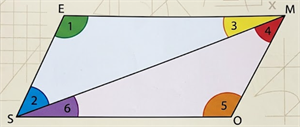
Step 1: Consider a general quadrilateral, such as quadrilateral SOME
Step 2: Draw a single diagonal, such as SM. This diagonal divides the quadrilateral into two distinct triangles: \(\Delta SEM\) and \(\Delta SOM\).
Step 3: Recall the Angle Sum Property of a Triangle, which states that the interior angles of any triangle add up to \(180°\)
- For \(\Delta SEM\), the sum of its angles is \(180^\circ\).
- For \(\Delta SOM\), the sum of its angles is also \(180^\circ\)
Step 4: Adding the angles of both triangles together covers all the interior angles of the original quadrilateral.
Total Sum \(= 180^\circ (\text{Triangle 1}) + 180^\circ (\text{Triangle 2}) = 360^\circ\)
Important!
Consistency: The sum is always 360°, no matter how "stretched" or "squashed" the quadrilateral is.
Impossible Shapes: This property explains why you cannot construct a quadrilateral with three right angles (90°) and a fourth angle that is not a right angle .
Example:
\(90^\circ + 90^\circ + 90^\circ + x = 360^\circ \rightarrow 270^\circ + x = 360^\circ \rightarrow x = 90^\circ\).
The fourth angle must be \(90°\) for the shape to exist.