

let us learn about another special type of quadrilateral.
In everyday life, we often come across slanted four-sided shapes. These shapes with opposite sides parallel are called parallelograms.
A parallelogram is a quadrilateral in which both pairs of opposite sides are parallel.
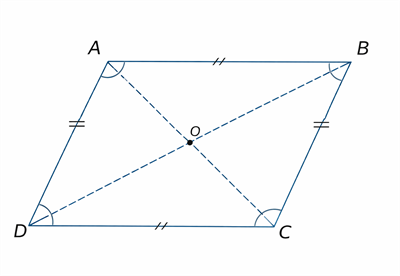
A parallelogram has its following properties
- The opposite sides are equal and parallel.
- The opposite angles are equal.
- Adjacent pairs of angles add up to \(180^\circ\).
- The diagonals of a parallelogram need not to be equal.
- The diagonals bisect each other.
- Each diagonal divides the parallelogram into two congruent triangles.
Observe the sides
Consider a parallelogram \(ABCD\).
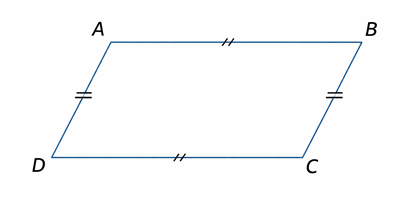
What do you notice while measuring the length of its sides?
By the property, "The opposite sides are equal and parallel."
\(\Rightarrow AB = CD\) and \(AD = BC\)
\(\Rightarrow AB \parallel CD\) and \(AD \parallel BC\)
Observe the angles
What do you notice about the angles of parallelogram?
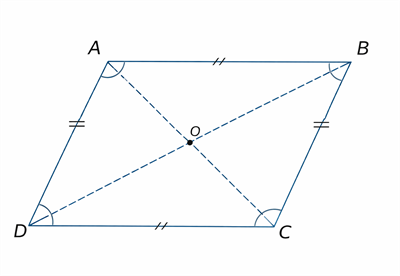
Based on the properties, "Opposite angles are equal".
you will find that,
\(\Rightarrow \angle A = \angle C\) and \(\angle B = \angle D\)
Let's check adjacent angles
Now by adding two neighbouring angles, you will notice that the sum is \(180^\circ\).
That is, "Adjacent angles of a parallelogram are supplementary".
Example:
\(\Rightarrow \angle A + \angle B = 180^\circ\)
Let's explore the diagonals
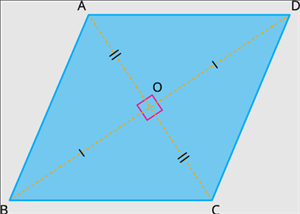
Draw the diagonals \(AC\) and \(BD\) of parallelogram \(ABCD\).
Let them intersect at point \(O\).
Based on the property, "The diagonals of a parallelogram bisect each other".
Also, they divide eath other into two equal parts.
By measuring the lengths, you can observe that,
\(\Rightarrow AO = OC\) and \(BO = OD\)
Intersecting observation about Congruency
Draw a diagonal \(BD\).
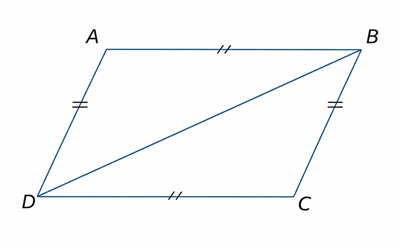
Now look at the two triangles formed and you'll find that,
\(\Rightarrow \triangle ABD \cong \triangle BDC\)
Therefore, " A diagonal of a parallelogram divides it into two congruent triangles".
Important!
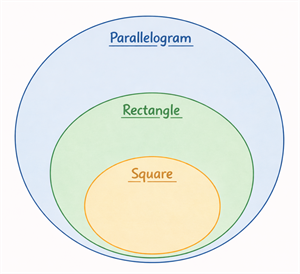
A rectangle is a special kind of parallelogram with all its angles equal to \(90^\circ\).
Here, the Venn diagram representation of these two sets would be as follows.
A parallelogram with all sides are equal is called a rhombus.
Now we are going to define a rhombus \(ABCD\) as a quadrilateral is a parallelogram with all the sides are in equal measures.
Thus, if \(ABCD\) is a rhombus then \(AB = BC = CD = AD\), \(AB || CD\) and \(BC || AD\).
Important!
Rhombus is a special case of kite. Note that the sides of a rhombus are all of the same length; this is not the case with the kite.
A rhombus has all the properties of a parallelogram and also that of a kite.
In a rhombus, the following properties are true:
- The sum of all the four angles of the rhombus is equal to \(360°\).
- The opposite sides are equal in length.
- The opposite angles are equal in measure.
- The adjacent angles are supplementary.
- The diagonals are perpendicular bisector of each other.
A quadrilateral with two pairs of equal adjacent sides and unequal opposite sides is called a kite.
Now we are going to define a kite \(ABCD\) is a quadrilateral having two pairs of equal adjacent sides and unequal opposite sides.
Thus, if \(ABCD\) is a kite, then \(AB = AD\) and \(BC = CD\).
Important!
Rhombus is a special case of kite. Note that the sides of a rhombus are all of the same length; this is not the case with the kite.
A rhombus has all the properties of a parallelogram and also that of a kite