

Look around you! Many objects in daily life, such as a book, a window, a television screen, or a floor tile, have four sides.
Shapes like these are examples of quadrilaterals. A quadrilateral is a closed figure made up of four line segments.
The word quadrilateral comes from two Latin words:
- Quadri means four
- Latus means side
Therefore,
A quadrilateral is a polygon having four sides, four vertices, and four angles.
Diagonals: A diagonal of a quadrilateral is a line segment joining two non-adjacent (opposite) vertices. Every quadrilateral has exactly \(2\) diagonals.
Linear pair: A pair of adjacent angles formed when two lines intersect and whose non-common arms form a straight line. The sum of the angles is \(180^{\circ}\).
Vertically opposite angles: When two lines intersect (like the diagonals of a quadrilateral), they form two pairs of vertically opposite angles, and each pair is equal. If two lines \(AC\) and \(BD\) intersect at \(O\), then \(∠AOB = ∠COD\), and \(∠AOD = ∠BOC\).
Angles in a Quadrilateral
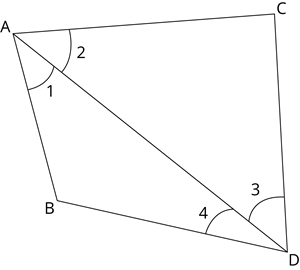
Consider a quadrilateral \(ABDC\).
Cut the quadrilateral into two triangles by drawing one of its diagonals \(AD\).
From the figure, \(\angle 1 + \angle 2 = \angle A\) and \(\angle 3 + \angle 4 = \angle D\).
Applying angle sum property in \(\triangle ABD\), we have:
\(\angle BAD + \angle ABD + \angle ADB = 180^{\circ}\)
\(\angle 1 + \angle B + \angle 4 = 180^{\circ}\) ---- (\(1\))
Applying angle sum property in \(\triangle ACD\), we have:
\(\angle DAC + \angle ACD + \angle CDA = 180^{\circ}\)
`
\(\angle 2 + \angle C + \angle 3 = 180^{\circ}\) ---- (\(2\))
Adding equations (\(1\)) and (\(2\)), we get:
\(\angle 1 + \angle B + \angle 4 + \angle 2 + \angle C + \angle 3 = 180^{\circ} + 180^{\circ}\)
\((\angle 1 + \angle 2) + \angle B + (\angle 3 + \angle 4) + \angle C = 360^{\circ}\)
\(\angle A + \angle B + \angle C + \angle D = 360^{\circ}\)
Thus, the sum of all angles of a quadrilateral is \(360^{\circ}\).
Types of quadrilaterals
There are various types of quadrilaterals. They are:
- Square
- Rectangle
- Parallelogram
- Trapezium
- Rhombus
- Kite
A square is a quadrilateral with four equal sides and four right angles.
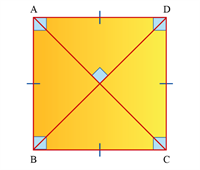
A square has:
-
four equal sides \(AB=BC=CD=DA\).
-
four right angles \(∠A=∠B=∠C=∠D=90°\).
-
two pairs of parallel sides \(AB∥DC\) and \(AD∥BC\).
-
two equal diagonals \(AC=BD\).
-
diagonals that are perpendicular to each other \(AC⊥BD\).
-
diagonals that bisect each other. That is, one diagonal divides the other diagonal into exactly two halves.
- diagonals bisect the angles.
A rectangle is a quadrilateral with two pairs of equal and parallel opposite sides and four right angles.
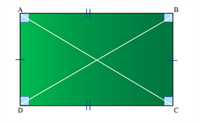
A rectangle has:
-
two pairs of parallel sides \(AB∥DC\) and \(AD∥BC\).
-
four right angles \(∠A=∠B=∠C=∠D=90°\).
-
opposite sides of equal lengths \(AB=DC\) and \(AD=BC\)
-
two equal diagonals \(AC=BD\)
-
diagonals that bisect each other. That is, one diagonal divides the other diagonal into exactly two halves.
A parallelogram is a quadrilateral in which both pairs of opposite sides are parallel.
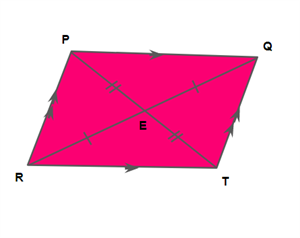
A parallelogram has:
- two pairs of parallel sides \(PQ∥RT\) and \(PR∥QT\).
- opposite sides of equal lengths \(PQ=RT\) and \(PR=QT\).
- opposite angles are equal \(∠P=∠T\) and \(∠Q=∠R\).
- Two diagonals that bisect each other. That is, one diagonal divides the other diagonal into exactly two halves.
A trapezium is a quadrilateral with atleast one pair of parallel opposite sides.
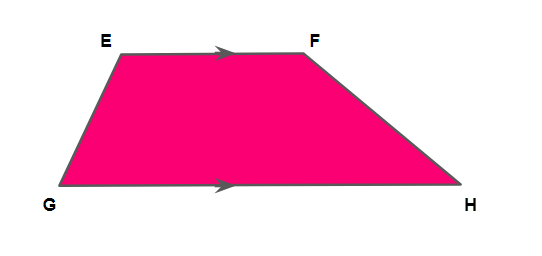
- The sides that are parallel to each other are called bases.
In the figure above, \(EF\) and \(GH\) are the bases.
- The sides that are not parallel to each other are called legs.
In the above figure, \(EG\) and \(FH\) are legs.
But if the two non-parallel opposite sides are of equal length, then it is called an isosceles trapezium.
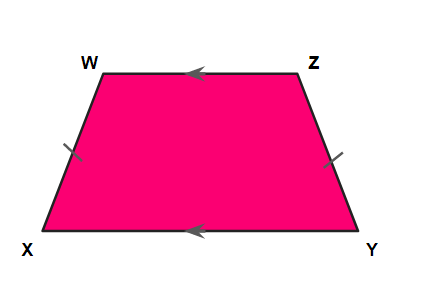
The quadrilateral \(XYZW\) above is an isosceles trapezium if \(XW = YZ\).
In an isosceles trapezium, the lengths of the diagonals are equal. That is \(XZ = WY\).
A rhombus is a quadrilateral with four equal sides.
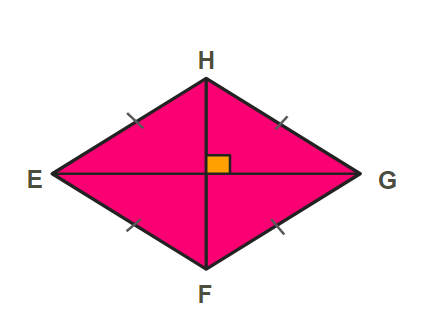
A rhombus has:
- two pairs of parallel sides \(EH∥FG\) and \(EF∥HG\).
- four equal sides \(EH=HG=GF=FE\).
- opposite angles are equal \(∠E=∠G\) and \(∠H=∠F\).
- diagonals that are perpendicular to each other \(EG⊥HF\).
- diagonals that bisect each other. That is, one diagonal divides the other diagonal into exactly two halves.
- diagonals bisect the angles.
A kite is a quadrilateral in which two pairs of adjacent sides are equal.
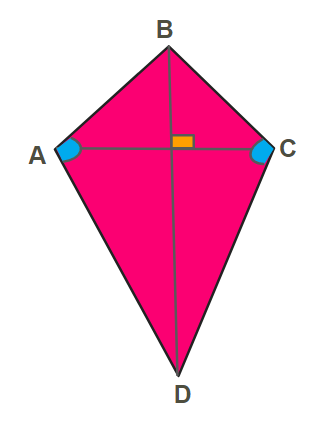
A kite has:
- two pairs of equal adjacent sides \(AB=BC\) and \(CD=DA\).
- one pair of opposite angles (which are obtuse) that are equal \(∠A=∠C\)
- diagonals that are perpendicular to each other \(AC⊥BD\)
- a longer diagonal that bisects the shorter diagonal.
- diagonals bisect the angles.