

Kite
A quadrilateral with two pairs of equal adjacent sides and unequal opposite sides is called a kite.
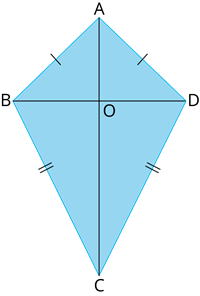
If \(ABCD\) is a kite, then \(AB = AD\) and \(BC = CD\).
Property 1: One diagonal (the one joining the vertices of the unequal side pairs) bisects the pair of angles at its two endpoints.
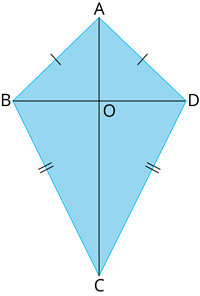
Proof:
Consider \(\triangle BCA\) and \(\triangle DCA\).
\(AB = AD\) [Adjacent sides of kite]
\(BC = DC\) [Adjacent sides of kite]
\(AC = AC\) [Common side]
Thus, \(\triangle BCA \cong \triangle DCA\) [By SSS congruence rule]
\(\angle BAC = \angle DAC\) [By CPCT]
And, \(\angle BCA = \angle DCA\) [By CPCT]
Therefore, \(AC\) bisects \(\angle BAD\) and \(\angle BCD\).
Property 2: One diagonal is the perpendicular bisector of the other diagonal, and it bisects the other diagonal.
To prove: \(BO = DO\) and \(\angle BOC = \angle DOC = 90^{\circ}\)
Proof:
Consider \(\triangle BOC\) and \(\triangle DOC\).
\(BC = DC\) [Adjacent sides of kite]
\(\angle BCO = \angle DCO\) [Diagonal \(AC\) bisects angle \(C\)]
\(OC = OC\) [Common side]
Thus, \(\triangle BOC \cong \triangle DOC\) [By SAS congruence rule]
\(BO = DO\) [By CPCT]
Thus, diagonal \(AC\) bisects diagonal \(BD\).
Also, \(\angle BOC = \angle DOC\) ---- (\(1\))
Consider the straight line \(BD\).
\(\angle BOC + \angle DOC = 180^{\circ}\)
\(\angle BOC + \angle BOC = 180^{\circ}\) [Using (\(1\))]
\(2 \angle BOC = 180^{\circ}\)
\(\angle BOC = \frac{180^{\circ}}{2}\)
\(\angle BOC = 90^{\circ}\)
Thus, \(\angle BOC = \angle DOC = 90^{\circ}\)
Trapezium
A quadrilateral with one pair of parallel sides is called a trapezium.
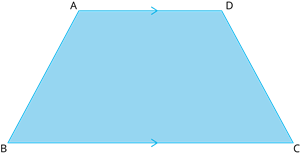
If \(ABCD\) is a trapezium, then \(AD\) is parallel to \(BC\).
Property 1: Angles on the same side of a leg are supplementary.
Since \(AD \parallel BC\) and \(AB\) is the transversal, then \(\angle A + \angle B = 180^{\circ}\) because interior angles on the same side of the transversal are supplementary.
Similarly, \(AD \parallel BC\) and \(CD\) is the transversal, then \(\angle C + \angle D = 180^{\circ}\) because interior angles on the same side of the transversal are supplementary.
Therefore, \(\angle A + \angle B = 180^{\circ}\) and \(\angle C + \angle D = 180^{\circ}\).
Isosceles trapezium
A trapezium is an isosceles trapezium if its non-parallel sides are equal.
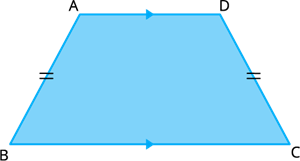
A quadrilateral \(ABCD\) is an isosceles trapezium, if \(AD \parallel BC\) and \(AB = DC\).
Property 2: In an isosceles trapezium, the two angles at each parallel(base) side are equal.

Draw two perpendicular lines \(XY\) and \(WZ\) from \(X\) and \(W\) onto \(UV\).
Since \(XW \parallel UY\), \(a + \angle XYZ = 180^{\circ}\) [Using property 1]
\(\Rightarrow a = 180^{\circ} - \angle XYZ\)
\(a = 180^{\circ} - 90^{\circ} = 90^{\circ}\)
Similarly, \(b + \angle WZX = 180^{\circ}\) [Using property 1]
\(\Rightarrow b = 180^{\circ} - \angle WZX\)
\(b = 180^{\circ} - 90^{\circ} = 90^{\circ}\)
Since all angles in a quadrilateral \(XYZW\) are \(90^{\circ}\), then the quadrilateral is a rectangle.
Consider \(\triangle UXY\) and \(\triangle VWZ\).
\(UX = VW\) [Given]
\(XY = WZ\) [Opposite sides of a rectangle are equal]
\(\angle XYU = \angle WZV = 90^{\circ}\)
Thus, \(\triangle XYU \cong \triangle WZV\) [By RHS congruence rule]
Therefore, \(\angle U = \angle V\) [By CPCT]