

1. The point of intersection of diagonals of a quadrilateral divides one diagonal in the ratio \(1:2\). Can it be a parallelogram? Why or why not?
2. In the given parallelogram \(YOUR\), \(\angle\)\(RUO\) \(=117^{\circ}\) and \(OY\) is extended to point \(S\) such that \(\angle\)\(SRY=57^{\circ}\).
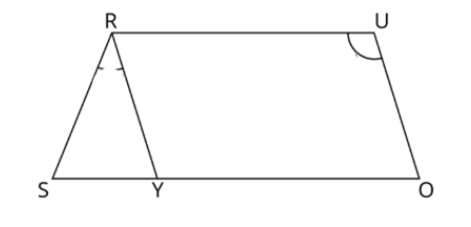
Find \(\angle\)\(YSR\) \(^{\circ}\)
Answer variants:
\(180\)
Cannot be a parallelogram
Can be a parallelogram
\(60\)