

Let us learn about squares and their properties.
Many objects around us, like a chessboard, a tile, or a window pane, have the shape of a square.
A square is easily recognized because it has four equal sides and four right angles.
A square is a quadrilateral in which all four sides are equal and all four angles are right angles.
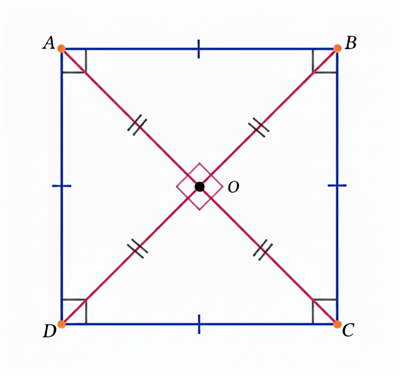
The properties of square are
- All the sides of a square are equal.
- The opposite sides of a square are parallel to each other.
- All angles of a square are \(90^\circ\).
- The diagonals of a square are of equal.
- The diagonals bisect each other at \(90^\circ\).
Understanding the sides and angles of square
Consider a square \(ABCD\).
-
\(AB, BC, CD, DA\) are the sides of the square.
- \(AB=BC=CD=DA\)
- \(AB \parallel DC\) and \(AD \parallel BC\)
- \(\angle A=\angle B=\angle C=\angle D = 90^\circ\)
Let's explore diagonal properties
In a square \(ABCD\),
- \(AC\) and \(BD\) are the diagonals of the square.
- In a square, diagonal is an angle bisector and forms alternate angles.
From the properties of square,
- \(\angle AOB = \angle BOC = \angle COD = \angle DOA = 90^\circ\)
- \(\triangle AOB, \triangle BOC, \triangle COD, \triangle DOA\) are the four congruent triangles formed by the diagonals \(AC\) and \(BD\).
- The congruency is verified between the triangles by \(SSS\) congruence condition
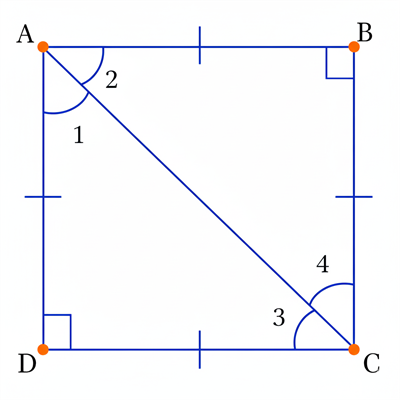
- Here, \(\angle 1\) and \(\angle 4\) are alternate angles.
- Similarly, \(\angle 2\) and \(\angle 3\) are alternate angles.
- Diagonal \(AC\) is an angle bisector and form two congruent triangles \(\triangle ADC\) and \(\triangle ABC\).
In \(\triangle ADC\), we have,
\(\angle 1 + \angle 3 + 90^\circ = 180^\circ\)
Since \(AD = DC\), we have \(\angle 1 = \angle 3\).
\(\angle 1 + \angle 1 + 90^\circ = 180^\circ\)
\( 2 \angle 1 = 180^\circ - 90^\circ\)
\(2 \angle 1 = 90^\circ\)
\(\angle 1 = \frac{90^\circ}{2}\)
\(\angle 1 = 45^\circ\)
Therefore, diagonal \(AC\) spilts the corner angles \(\angle A\) and \(\angle C\) as two equal angles.
Thus, \(\angle 1 = \angle 3 = 45^\circ\)
Similarly, In \(\triangle ABC\) we get , \(angle 2 = \angle 4 = 45^\circ\)
Important!
- A square is a special type of rectangle.
- Every square is a rectangle, but every rectangle is not a square.
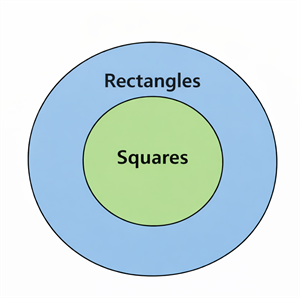
Let us learn about "Rectangles" and understand their important properties.
We often see shapes like books, doors, blackboards, and mobile screens around us. These shapes have four sides and four right angles. Such shapes are called rectangles.
A rectangle is a quadrilateral in which has four sides and all four angles are right angles \((90^\circ)\).
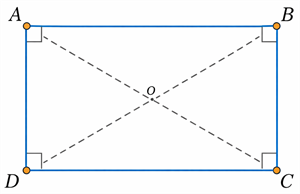
Properties of a Rectangle
A rectangle has the following important properties:
-
All four angles are right angles (each angle is \(90^\circ\)).
-
Opposite sides are equal in length.
-
Opposite sides are parallel to each other.
-
The diagonals of a rectangle are equal.
-
The diagonals bisect each other, that is, they intersect at their midpoints.
Let's explore sides and angles of rectangle
Consider rectangle \(ABCD\).
-
\(AB, BC, CD\) and \(DA\) are the sides.
- \(AB=BC= CD=DA\)
- \(\angle A = \angle B = \angle C = \angle D = 90^\circ\)
From the properties of rectangle, we know that "opposite sides are equal and parallel."
- \(AB = DC\) and \(AD = BC\)
- \(AB \parallel DC\) and \(AD \parallel BC\)
Also, "Alternate angles are equal"
Since \(AB \parallel CD\)
- \(AC\) acts as transversal, we get \(\angle BAC =\angle ACD\)
-
\(BD\) acts as transversal, we get \(\angle ABD =\angle BDC\)Since, \(AD \parallel BC\)
- \(AC\) acts as transversal, we get \(\angle DAC =\angle ACD\)
- \(BD\) acts as transversal, we get \(\angle CBD =\angle BDA\)
Understanding Diagonals of a rectangle
Consider rectangle \(ABCD\).
-
\(AC\) and \(BD\) are the diagonals.
-
They intersect at a point \(O\).
From the properties of a rectangle:
- \(AC=BD\)
- \(AO=OC\)
- \(BO=OD\)
Important!
This means the diagonals cut each other into two equal parts.
Interesting Observation:
When the diagonals intersect:
-
Vertically opposite angles are equal.
-
Adjacent angles form linear pairs, so their sum is \(180^\circ\).
From the properties of a rectangle:
- \(\angle AOB = \angle DOC\)
- \(\angle AOD = \angle BOC\)
Important!
This helps us find unknown angles formed between the diagonals.