

A designer creates a decorative pattern using three quadrilaterals: a rhombus, a kite, and a trapezium.
Design 1: Rhombus \(ABCD\) with diagonals \(AC\) and \(BD\) intersect at \(O\).
Design 2: Kite \(PQRS\) with adjacent sides \(PQ = PS\) and \(SR = QR\). Its diagonals intersect at \(M\). The diagonal \(PR\) is the perpendicular bisector of \(SQ\).
Design 3: Trapezium \(WXYZ\) has \(WX \parallel ZY\), with \(WX = 8 \ cm\) and \(YZ = 13 \ cm\).
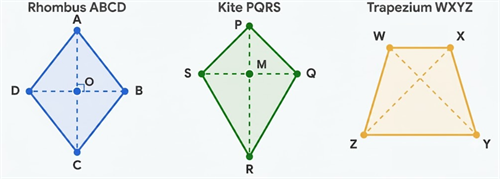
1. If \(\angle A = 57^{\circ}\), then \(\angle B =\) \(^{\circ}\)
2. If the length of the diagonal \(SQ = 19 \ cm\), then \(SM =\) \(cm\)
3. Which of the following conditions is true if \(WXYZ\) is an isosceles trapezium?
4. Which design has two pairs of adjacent equal sides?