

1. Quadrilaterals with equal side lengths
Are squares the only quadrilaterals with all sides equal?
A rhombus is a special parallelogram.
Every rhombus is a parallelogram, but every parallelogram is not a rhombus
A rhombus is a quadrilateral in which all four sides are equal.
Now we are going to define a rhombus as a quadrilateral is a parallelogram with all the sides are in equal measures.
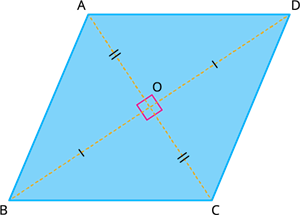
Thus, if \(ABCD\) is a rhombus then \(AB=BC=CD=AD\), \(AB||CD\) and \(BC||AD\).
Deduction 9: In a Rhombus, Opposite Angles are Equal.
Deduction 10: Diagonals of a Rhombus are perpendicular bisector of each other.
Properties of a rhombus
1. All four sides are equal in length.
2. Opposite sides are parallel.
3. Opposite angles are equal.
4. Adjacent angles add upto \(180^{\circ}\).
5. Diagonals bisect each other.
6. Diagonals intersect at \(90^{\circ}\).
7. Diagonals bisect the angles of the rhombus
8. Diagonals are not necessarily equal.
Joining triangles
Every quadrilateral can be split into two triangles by drawing a diagonal. The reverse is also true. If we take two triangles and join them along an equal side, the outer boundary forms a quadrilateral. The quadrilateral we get depends on the type of triangles we start with.
Case 1: A quadrilateral formed from two equilateral triangles.
When \(2\) equilateral triangles are joined along one side:
- All four sides of the new figure become equal.
- Opposite sides become parallel.
Example:
Let us consider two equilateral triangles of length \(3 \ cm\), and join them along one side.
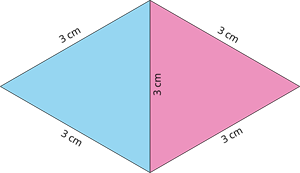
The quadrilateral formed is a rhombus because all four sides are equal and opposite sides are parallel.
Case 2: A quadrilateral formed from joining two isosceles triangles
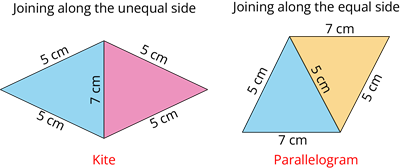
(a) Joining along the unequal side
When two isosceles triangles are joined along the unequal side, then the resulting quadrilateral has:
- Two pairs of adjacent sides are equal.
- One pair of opposite angles are equal.
- Adjacent sides are equal.
The quadrilateral formed is a kite.
(b) Joining along the equal side
When two isosceles triangles are joined along the equal side, then the resulting quadrilateral has:
- Opposite sides are equal and parallel
The quadrilateral formed is a parallelogram.
Example:
Let us consider two isosceles triangles of length \(5 \ cm\), \(5 \ cm\) and \(7 \ cm\).
Case 3: A quadrilateral formed from joining two scalene triangles.
Example:
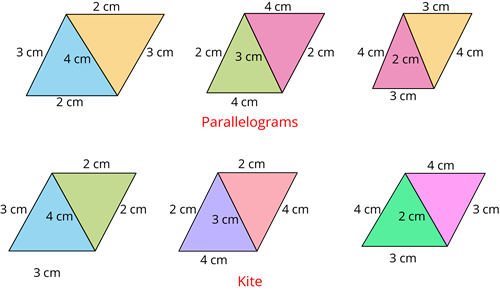
Let us consider two scalene triangles of length \(2 \ cm\), \(3 \ cm\) and \(4 \ cm\) and join along the sides.
Kite
A quadrilateral with two pairs of equal adjacent sides and unequal opposite sides is called a kite.
Property 1: One diagonal (the one joining the vertices of the unequal side pairs) bisects the pair of angles at its two endpoints.
- The sum of all four angles of the kite is equal to \(360°\).
- A kite has two pairs of equal adjacent sides.
- A kite has unequal opposite sides.
- The diagonals of a kite are perpendicular to each other.
- The longer diagonal bisects the shorter diagonal.
- In the figure, \(∠B=∠D\) but \(∠A \neq ∠C\).
Trapezium
A quadrilateral with one pair of parallel sides is called a trapezium.
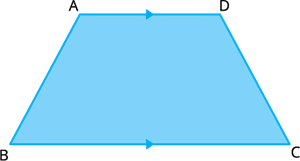
If \(ABCD\) is a trapezium, then \(AD\) is parallel to \(BC\).
Property 1: Angles on the same side of a leg are supplementary.
Isosceles trapezium
A trapezium is an isosceles trapezium if its non-parallel sides are equal.
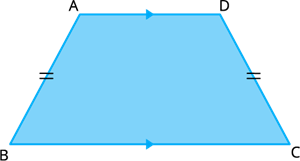
A quadrilateral \(ABCD\) is an isosceles trapezium, if \(AD \parallel BC\) and \(AB = DC\).
Property 2: In an isosceles trapezium, the two angles at each parallel(base) side are equal.
In an isosceles trapezium, the following properties are true:
- Exactly one pair of parallel sides and one pair of congruent sides.
- Diagonals are congruent and do not bisect each other.
- Base angles are congruent, and opposite angles are supplementary.