

Geometrical Reasoning:
How do Mathematicians Think?
"In Geometry, we should never jump directly to the answer.
Every statement should have a reason."
Instead of writing, \(∠A = 70°\)
Write, \(∠A = 70°\) (Opposite angles of a parallelogram are equal.)
Every line should answer the question
"Why?"
That is called Geometrical Reasoning.
The Four Steps of Geometrical Reasoning
Step 1: Observe the figure carefully (with given information).
Ask yourself: Which shape is given? (Rectangles, Square, Rhombus, Kite, Trapezium, Parallelogram)
Ask yourself: Which shape is given? (Rectangles, Square, Rhombus, Kite, Trapezium, Parallelogram)
Step 2: Recall the properties of that figure.
Step 3: Find which property is useful.
Not every property is required.
Only choose the property that helps.
Step 4: Write Statement and Reason
Like this:
| Statement | Reason |
|---|---|
| \(AB = CD\) | Opposite sides of a parallelogram are equal |
| \(∠A = ∠C\) | Opposite angles are equal |
| \(∠A + ∠B =180°\) | The sum of adjacent angle of rhombus is \(180^\circ\) |
Example:
What type of a quadrilateral is one in which the opposite sides are equal? Justify your answer.
Hint: Draw a diagonal and check for congruent triangles.
Hint: Draw a diagonal and check for congruent triangles.
Solution:
We know by property, "If a quadrilateral has opposite sides equal, then it is a parallelogram".
Let us prove this by geometrical reasoning using its diagonal by considering the given condition.
Consider the quadrilateral \(ABCD\) whose oppsite sides are equal and draw the diagonal \(AC\). Hence \(AB = CD\), \(BC = DA\) and \(AC\) is the diagonal.
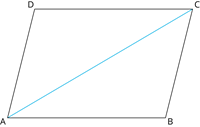
| Statement | Reason |
| In \(\triangle ABC\) and \(\triangle CDA\), \(AB = CD\) (given) \(BC = DA\) (given) \(AC = AC\) (common) |
From the given data |
| \(\triangle ABC = \triangle CDA\) | By SSS congruence |
| \(\angle BAC = \angle DCA\) and \(\angle ACB =\angle CAD\) | corresponding angles are equal |
| \(AB||DC\) and \(AD||BC\) | Alternate interior angles are equal and considering \(AC\) as transversal |
Hence, \(ABCD\) is a parallelogram as opposite sides of the quadrilateral are parallel.